Claude Fable 5 and Mythos 5: Anthropic's Most Capable Models, Explained
Claude Fable 5 is Anthropic's first Mythos-class model released for general use, launched June 9, 2026. It is the same underlying model as Claude Mythos 5, but with safety classifiers that redirect cybersecurity and biology queries to Claude Opus 4.8. Pricing is $10 per million input tokens and $50 per million output tokens. Businesses can access it via the Claude API using the model ID claude-fable-5.
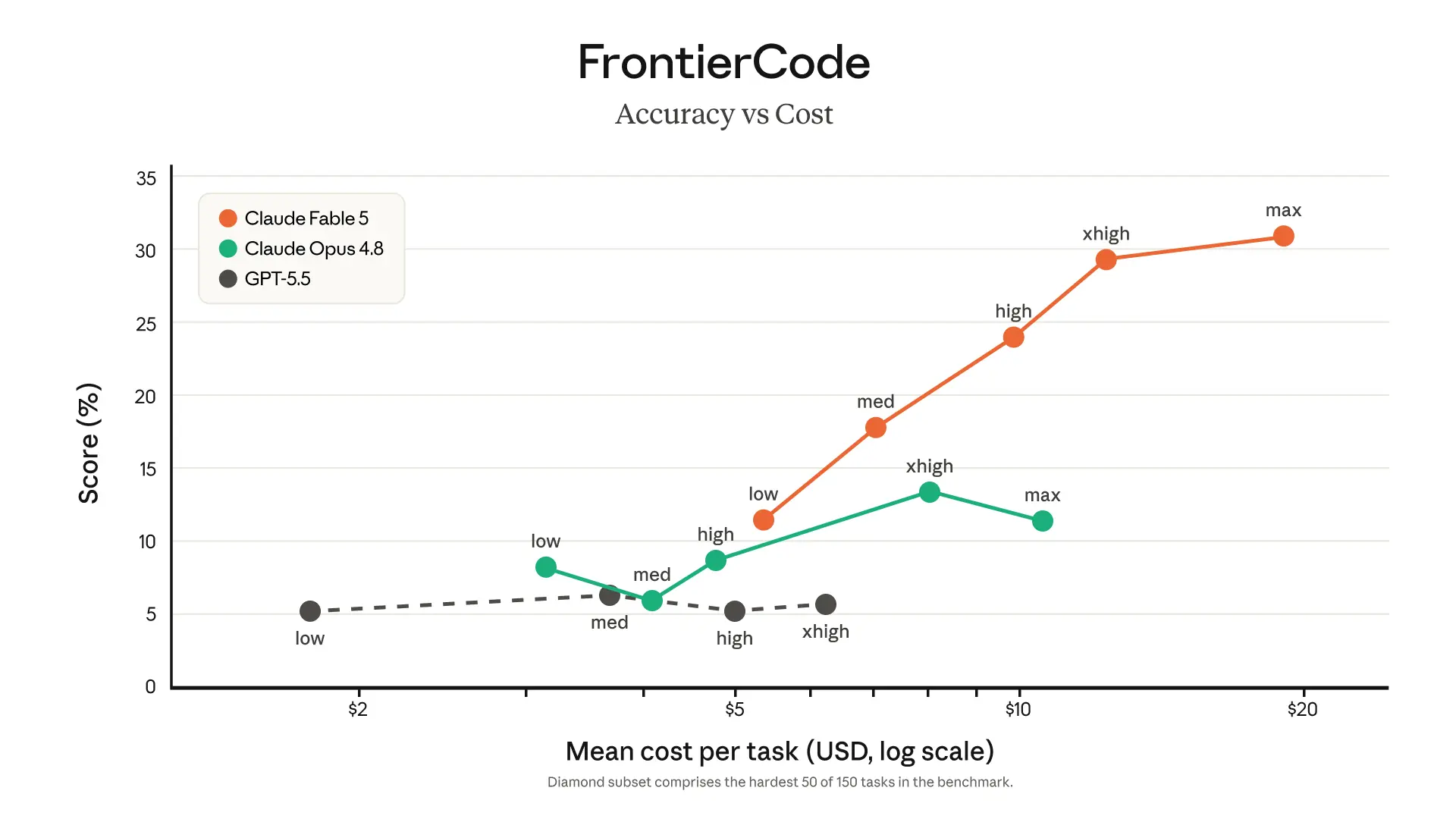
On June 9, 2026, Anthropic launched two models simultaneously: Claude Fable 5 for general use and Claude Mythos 5 for a restricted set of vetted partners. Both share the same weights. The distinction is not capability but access controls. Fable 5 is what most developers, businesses, and individual users will interact with. Mythos 5 is the same engine running without certain guardrails for cybersecurity teams and life sciences researchers.
This launch matters for two reasons. First, Fable 5's raw performance exceeds every Claude model Anthropic has previously released to the public, including on software engineering, vision, long-context work, and scientific reasoning. Second, it represents Anthropic's most explicit acknowledgment yet that frontier models require new infrastructure beyond training-time alignment, specifically runtime classifiers that intercept certain queries before the main model processes them.
What Is Claude Fable 5
Claude Fable 5 is a Mythos-class model, the tier Anthropic places above its Opus line. The first Mythos-class release was Claude Mythos Preview in April 2026, made available only through Project Glasswing for cyber defenders and critical infrastructure providers. Fable 5 makes that same capability tier generally available, with classifiers applied to manage dual-use risk.
The name is deliberate. "Fable" comes from the Latin fabula, meaning "that which is told," cognate with the Greek mythos. The safeguards are what separate the two models in practice, and Anthropic chose distinct names to reflect that distinction clearly. If you are building a product on the Claude API and do not need cybersecurity or advanced biology capabilities, Fable 5 will perform identically to Mythos 5 in the vast majority of sessions. Anthropic's data shows fewer than 5% of Fable sessions trigger a fallback to Opus 4.8.

Fable 5 vs Mythos 5: The Safeguard Divide
The two models are built on identical weights. What differs is which queries reach Fable 5 directly and which are intercepted and routed to Claude Opus 4.8. Understanding this split is important if you are evaluating either model for a specific use case.
Claude Fable 5
Available to all users and developers via the Claude API. Safety classifiers active for cybersecurity, biology and chemistry, and distillation queries. Less than 5% of sessions are affected. Priced at $10 input / $50 output per million tokens.
Claude Mythos 5
Same underlying model with cybersecurity classifiers removed for Project Glasswing partners and cyber defenders. Biology classifiers being lifted for select life sciences researchers. Not available for general API access.
For most product development work, the distinction is academic. If your application involves software development, customer intelligence, document processing, vision tasks, or knowledge work, Fable 5 behaves as if the classifiers do not exist. Integrate Claude Fable 5 into your product with Naraway
Benchmark Performance: The Full Picture
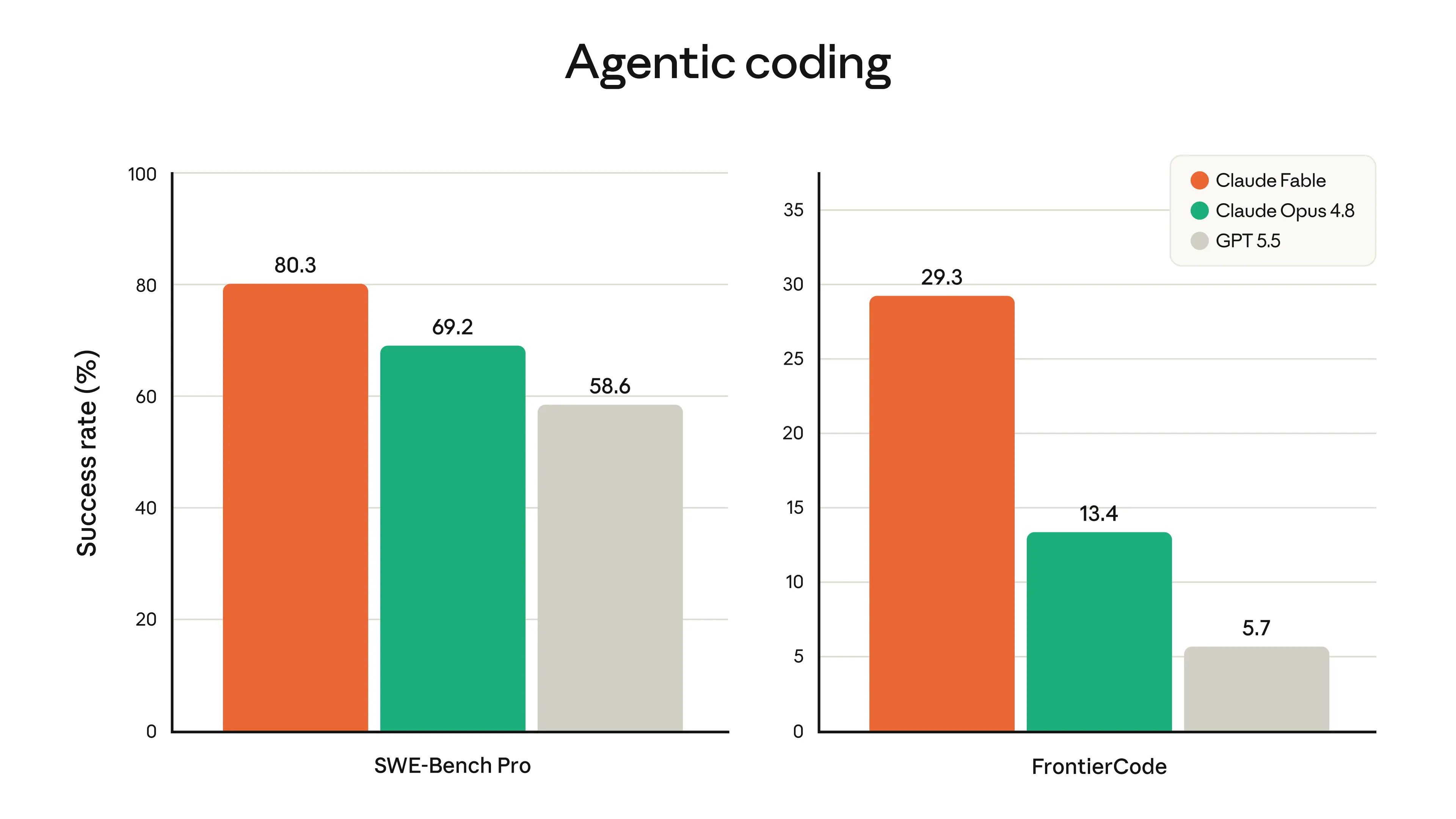
Fable 5 and Mythos 5 are evaluated together in Anthropic's published benchmarks, with the higher of the two scores reported. The table below includes all key evaluations from the launch with scores for competing frontier models.
| Benchmark | Fable 5 / Mythos 5 | Claude Opus 4.8 | GPT-5.5 | Gemini 3.1 Pro |
|---|---|---|---|---|
| Agentic Coding SWE-Bench Pro |
80.3% | 69.2% | 58.6% | 54.2% |
| Agentic Coding FrontierCode Diamond |
29.3% (xhigh) | 13.4% | 5.7% | — |
| Agentic Coding Terminal-Bench 2.1 |
88.0%* | 82.7% | 83.4% | 70.7% |
| Knowledge Work GDPval-AA |
1932 | 1890 | 1769 | 1314 |
| Knowledge Work Vision GDP.pdf |
29.8% | 22.5% | 24.9% | 16.7% |
| Spatial Reasoning Blueprint-Bench 2 |
38.6% | 14.5% | 36.2% | 26.5% |
| Tool Use AutomationBench |
17.4% | 15.5% | 12.9% | 9.6% |
| Computer Use OSWorld-Verified |
85.0% | 83.4% | 78.7% | 76.2% |
| Legal Legal Agent Benchmark |
13.3% | 10.4% | 2.1% | 0.0% |
| Multidisciplinary Reasoning Humanity's Last Exam (no tools) |
59.0%* | 49.8% | 41.4% | 44.4% |
| Cybersecurity ExploitBench Cap% |
78.0%* | 40.0% | 34.0% | — |
| Health HealthBench Professional |
66.0%* | 56.9% | 51.8% | — |
* Starred benchmarks show a larger gap between Fable 5 and Mythos 5 due to blocking safeguards on cybersecurity and biology queries. For these, Fable 5 performs closer to Claude Opus 4.8. Source: Anthropic launch announcement.
What Fable 5 Does Better
The benchmark lead is broad, but three areas stand out as qualitatively different from previous Claude releases.
Software Engineering
Stripe reported Fable 5 compressed months of engineering work into days on a 50-million-line Ruby codebase. The model executed a full migration in under 24 hours that would have taken a team of engineers more than two months by hand.
Vision
Fable 5 can rebuild a web application's source code from screenshots alone. Earlier Claude models required a helper harness to play Pokémon FireRed. Fable 5 completed the game using only raw game screenshots, with no maps or navigation aids.
Long-Context Memory
In a deck-building game evaluation (Slay the Spire), giving Fable 5 access to persistent file-based memory improved performance three times more than it improved Opus 4.8. The model uses its own notes across millions of tokens to stay on task.
Scientific Reasoning
Mythos 5 conducted over a week of autonomous genomics research, training a custom ML model on single-cell data from 138 animal species. It outperformed a model published in Science while being 100 times smaller in parameter count.
For businesses building on AI, the software engineering lead is the most immediately relevant figure. An 80.3% SWE-Bench Pro score means Fable 5 can handle complex, multi-file codebase operations autonomously, which directly reduces engineering overhead on internal tooling, migrations, and product development cycles. See how Naraway builds AI-native systems for growing businesses
How the Safety Classifiers Work
Fable 5's classifiers are separate AI systems that sit in front of the main model and intercept specific categories of requests. When a query matches a classifier's scope, the response is handled by Claude Opus 4.8 instead. Users are informed when this occurs. Anthropic built three distinct classifiers for this release.
Cybersecurity
Covers exploitation, offensive cyber tasks, reconnaissance, lateral movement, and agentic hacking. External bug bounties produced no universal jailbreaks across over 1,000 hours of testing.
Biology and Chemistry
Covers most requests related to biology and chemistry due to Mythos-class capability in gene therapy and viral design tasks. Tuned conservatively for the initial release, with narrowing planned.
Distillation
Detects large-scale extraction of Claude's capabilities to train competing models. Flagged attempts fall back to Opus 4.8. Prevents near-frontier capability proliferation without appropriate safeguards.
A key practical point: Anthropic's internal data shows that in more than 95% of sessions, Fable 5's classifiers never trigger. For product teams building applications outside these three domains, the experience is identical to Mythos 5.
Building AI-Powered Products for Your Business?
Claude Fable 5 is a step-change in what's possible with API-based AI. The question is not whether the model is capable. It is whether your integration architecture is ready to use it well. System prompt design, tool use, context management, and cost optimisation all determine whether a capable model translates to a capable product.
Talk to Naraway's AI TeamPricing and Access
Both models are priced at $10 per million input tokens and $50 per million output tokens. This is less than half the price of Claude Mythos Preview. Fable 5 is fully available today via the Claude API.
For subscription plans (Pro, Max, Team, Enterprise), Fable 5 is included at no extra cost through June 22, 2026. After that date, usage credits are required until Anthropic restores it as a standard plan inclusion. Anthropic has committed to communicating any changes ahead of time.
A 30-day data retention policy applies to all Mythos-class model traffic. Anthropic will not use this data for model training, but retains it for safety monitoring, specifically to detect complex jailbreak attempts and cross-session attack patterns. All human access to retained data is logged, and deletion occurs after 30 days in almost all cases.
Should Your Business Use Claude Fable 5
Fable 5 is the right default for most new Claude integrations. The performance improvement over Opus 4.8 is meaningful across software development, document reasoning, knowledge work, and vision tasks. The classifier overhead affects fewer than 1 in 20 sessions for general-purpose applications.
Use Fable 5 if your team needs:
- Autonomous software engineering on large or complex codebases
- Document analysis, financial reasoning, or chart interpretation at scale
- Vision-based tasks including UI reconstruction or screenshot-to-code workflows
- Long-running agentic tasks that span many tool calls or require persistent memory
- Legal document analysis or structured knowledge extraction
- Cost efficiency at half the price of Claude Mythos Preview
Consider the constraints if:
- Your product is a cybersecurity tool and you need full, unfiltered exploit analysis capability
- You are doing advanced biomedical research requiring biology classifier removal
- Classifier fallbacks (even at 5%) would create unacceptable latency or response-consistency issues in your pipeline
For the vast majority of Indian startups and enterprises building on AI, none of those constraints apply. Software tools, customer automation, internal knowledge systems, and product intelligence workflows will see clear gains from Fable 5 with no practical downside. The right question is not whether to adopt Fable 5. It is whether your integration is architected to take full advantage of it. Naraway helps you build that architecture
The Bottom Line
Claude Fable 5 is the most capable generally available Claude model by a clear margin. An 80.3% SWE-Bench Pro score, a 29.3% FrontierCode Diamond result, and leadership across knowledge work, vision, legal reasoning, and tool use place it ahead of every competing frontier model on most enterprise-relevant tasks.
The safety classifier design is architecturally significant. Anthropic has moved from training-time safety properties to runtime interception for the highest-risk capability domains. This is a credible and practical approach for a general release. The fallback to Opus 4.8 means users get a highly capable response even when Fable 5 is bypassed, rather than an outright refusal.
For developers and businesses, the practical instruction is straightforward. Switch your integrations to claude-fable-5 and evaluate whether the performance gains justify the cost at your usage volume. For most workloads, they will.
Frequently Asked Questions
What is Claude Fable 5?
Claude Fable 5 is Anthropic's first Mythos-class AI model released for general use, launched on June 9, 2026. It exceeds all previously available Claude models on nearly every benchmark and includes safety classifiers for cybersecurity and biology domains.
What is the difference between Claude Fable 5 and Claude Mythos 5?
Fable 5 and Mythos 5 share the same underlying model weights. Fable 5 has safety classifiers active that redirect certain queries to Claude Opus 4.8. Mythos 5 has those classifiers removed for vetted partners. In practice, fewer than 5% of Fable 5 sessions are affected by the classifiers.
How much does Claude Fable 5 cost?
$10 per million input tokens and $50 per million output tokens. This is less than half the price of Claude Mythos Preview. Access the model via API using the ID claude-fable-5.
How does Claude Fable 5 compare to GPT-5.5?
Fable 5 leads on software engineering (SWE-Bench Pro 80.3% vs GPT-5.5's 58.6%), knowledge work, legal reasoning, and spatial reasoning. GPT-5.5 scores higher on OSWorld computer use (78.7% vs Fable 5's 85.0%). For most product development use cases, Fable 5 holds a clear advantage.
Is Claude Fable 5 suitable for Indian startups?
Yes. For software development, customer automation, document analysis, and knowledge work, Fable 5 is the best generally available model for these tasks. The classifier system does not affect standard business applications. Naraway can help you integrate and optimise it for your specific workload.