AI and Jobs in 2026: What the Evidence Really Says, and What Smart Employers Do Next
AI is not causing economy-wide job losses yet. Its real impact is on hiring: workers aged 22 to 25 in AI-exposed jobs now sit 19% below their peers, mostly because fewer are hired, not because more are fired. Demand is moving to AI skills instead: in India, AI and machine-learning hiring grew 25% year on year in June 2026.
Key takeaways
- No economy-wide AI job losses so far: unemployment in AI-exposed jobs has not risen.
- The impact is on hiring, not firing: young workers in exposed roles are 19% behind their peers.
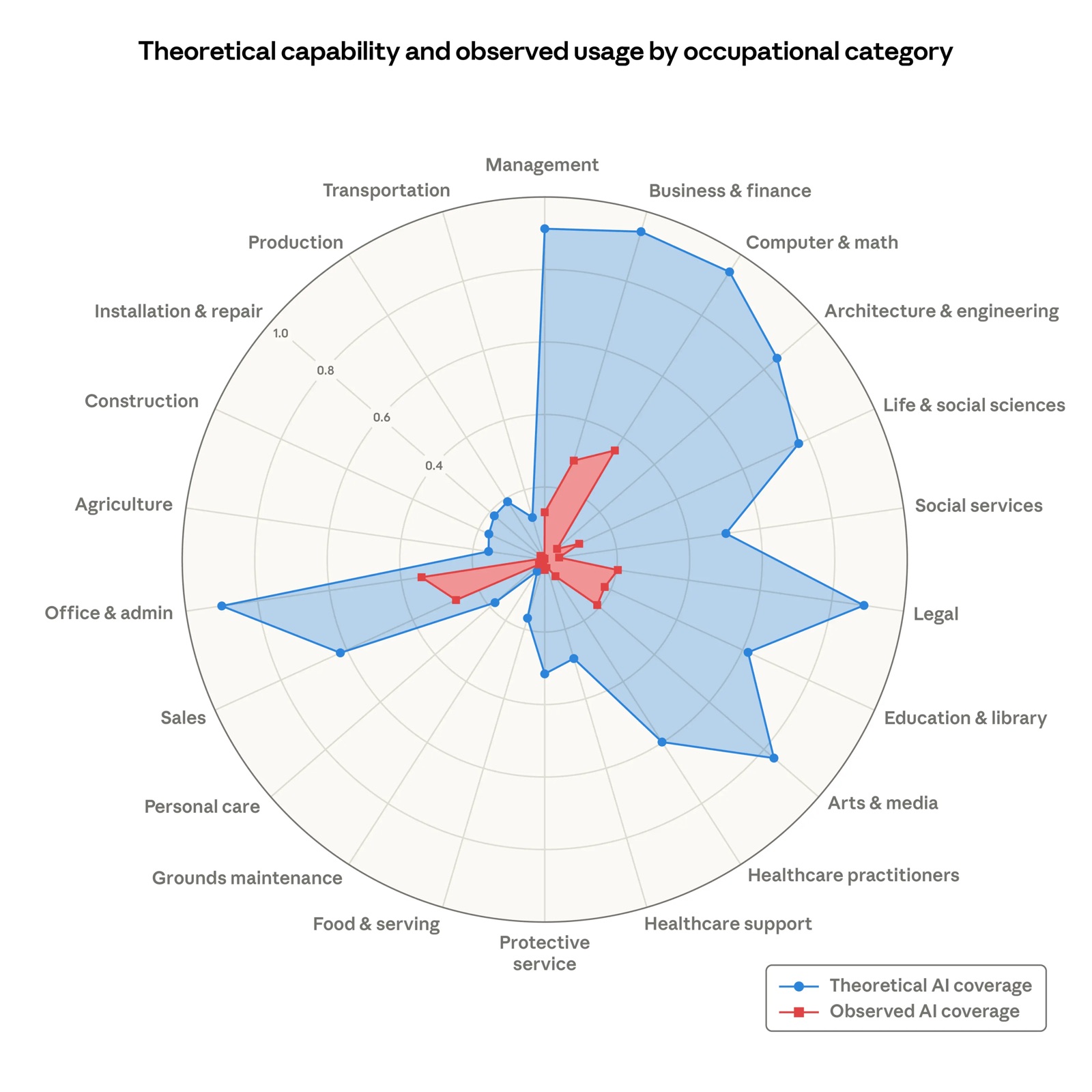
- AI exposure is highest in well-paid, highly educated work, not low-wage jobs.
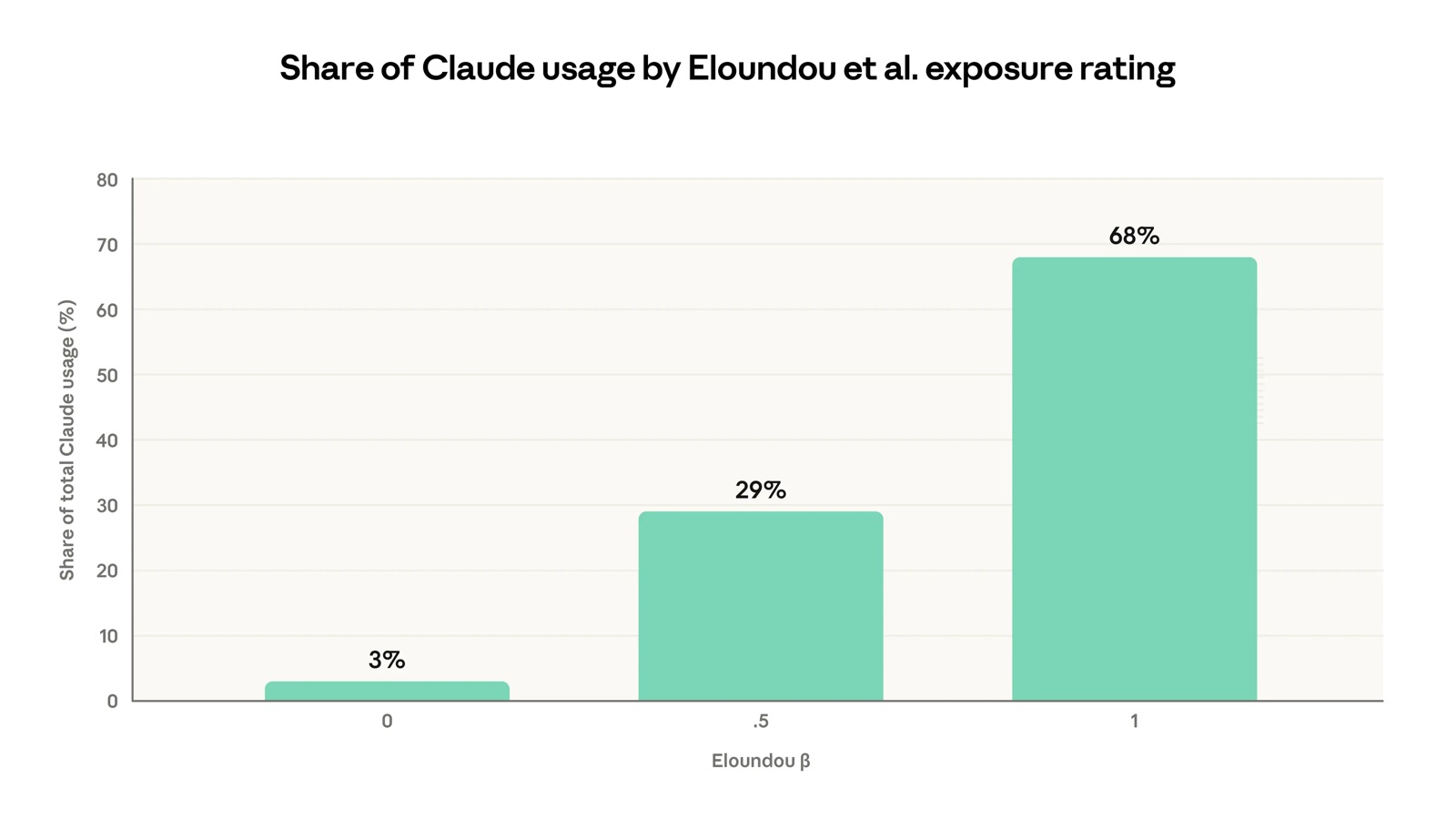
- Real AI usage predicts slower job growth; theoretical exposure does not.
- AI covers only 33% of computer and maths tasks, against 94% it could handle.
In this article
- Is AI Taking Jobs? Not Yet, at Scale
- AI and Entry-Level Jobs: The Job That Is Never Posted
- Five Findings Most Coverage Misses
- Which Jobs Are Most Exposed to AI?
- AI Hiring in India: Demand Moves to AI Skills
- The Future of Work to 2030
- AI Workforce Planning: What Smart Employers Do Next
- How We Compiled This
- The Bottom Line
- Sources
- FAQs
The headlines say AI is coming for jobs. The labour data says something sharper: AI is not firing people, it is changing who gets hired. For any employer planning next year's team, that difference decides whether you build a talent pipeline or quietly break one.
We reviewed the most credible research published up to October 2026, from US payroll studies to India's live hiring index. Here is what it shows, including five findings most coverage misses.
Is AI Taking Jobs? Not Yet, at Scale
Anthropic's March 2026 study, which maps real AI usage onto the tasks inside 800 occupations, finds "limited evidence that AI has affected employment to date." Unemployment among workers in the most AI-exposed jobs has not risen since late 2022, and the study was sensitive enough to detect a rise of around one percentage point.
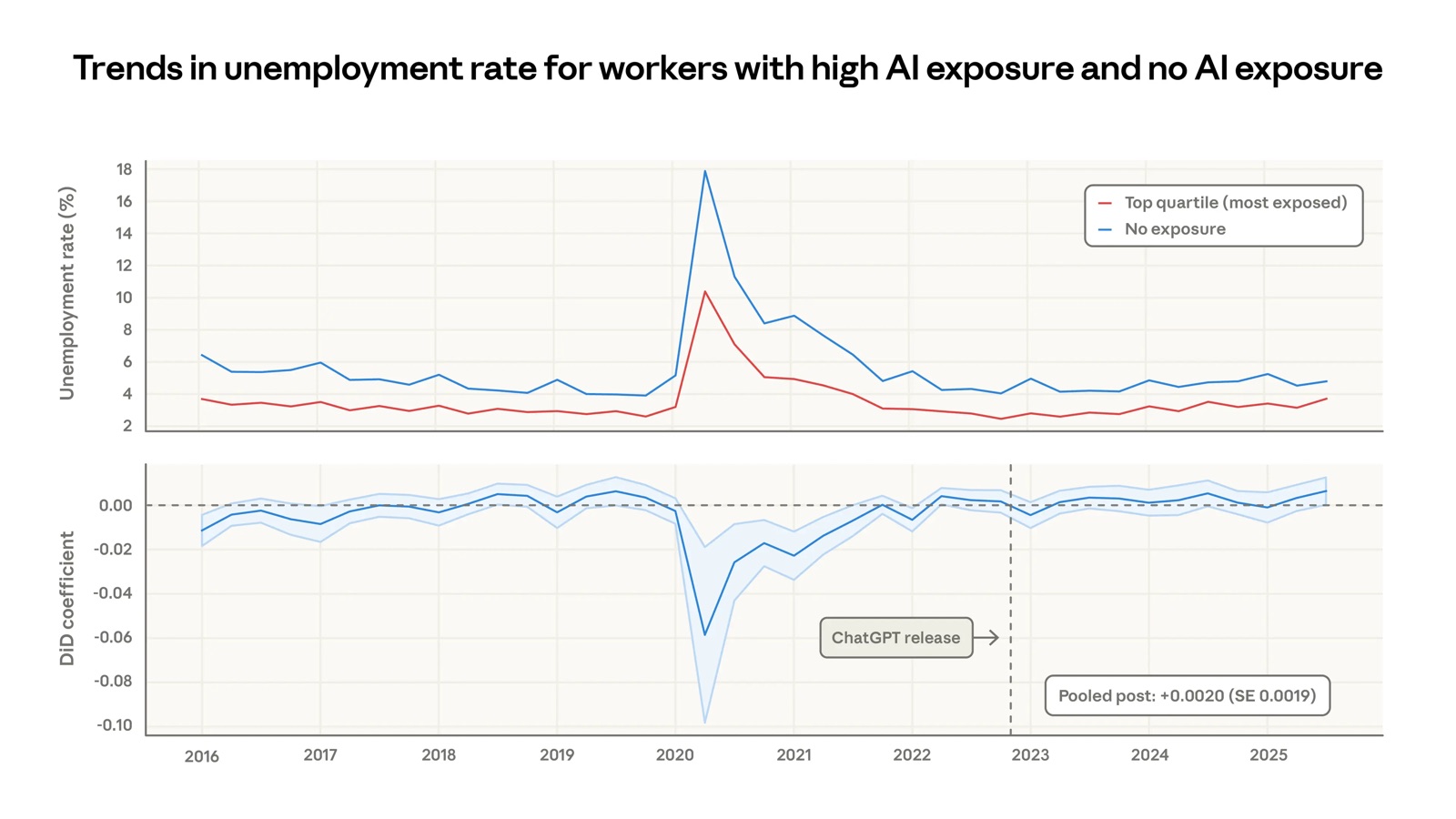
The Yale Budget Lab, writing with Brookings, agrees. The occupational mix is shifting only about one percentage point faster than in the early internet era, and the share of workers in the most exposed jobs has held at around 18% since early 2023. As the Lab's executive director Martha Gimbel put it, "there don't appear to be major macroeconomic effects at this moment."
AI and Entry-Level Jobs: The Job That Is Never Posted
The impact of AI on jobs shows up at the door, not the exit. Stanford's Digital Economy Lab, using payroll data, finds that workers aged 22 to 25 in the most AI-exposed jobs now stand 19% below where they would be had they kept pace with less-exposed peers. The researchers note the gap "has widened steadily since we first documented it in August 2025," and that it runs mainly through reduced hiring, not more separations. It holds even after excluding tech firms and remote-friendly jobs.
Sources: Stanford Digital Economy Lab (August 2026); Anthropic (March 2026); Yale Budget Lab via Brookings.
AI's first casualty is not the employee. It is the job that never gets posted.
Five Findings Most Coverage Misses
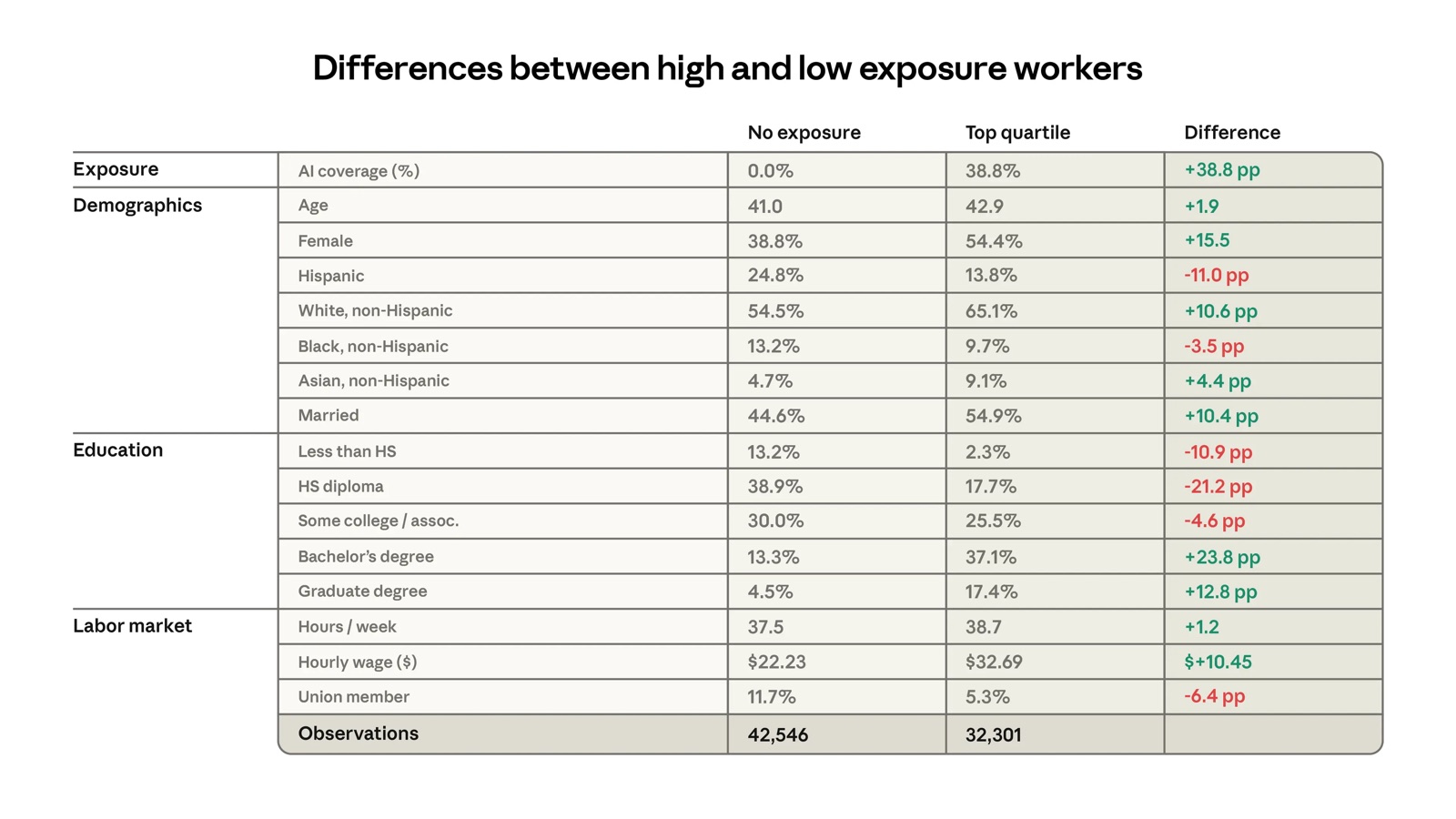
- The most exposed workers are the best paid. In Anthropic's data, workers in the most AI-exposed jobs earn 47% more on average, and 17.4% hold graduate degrees against 4.5% in unexposed jobs. AI is moving up the skills ladder, not starting at the bottom.
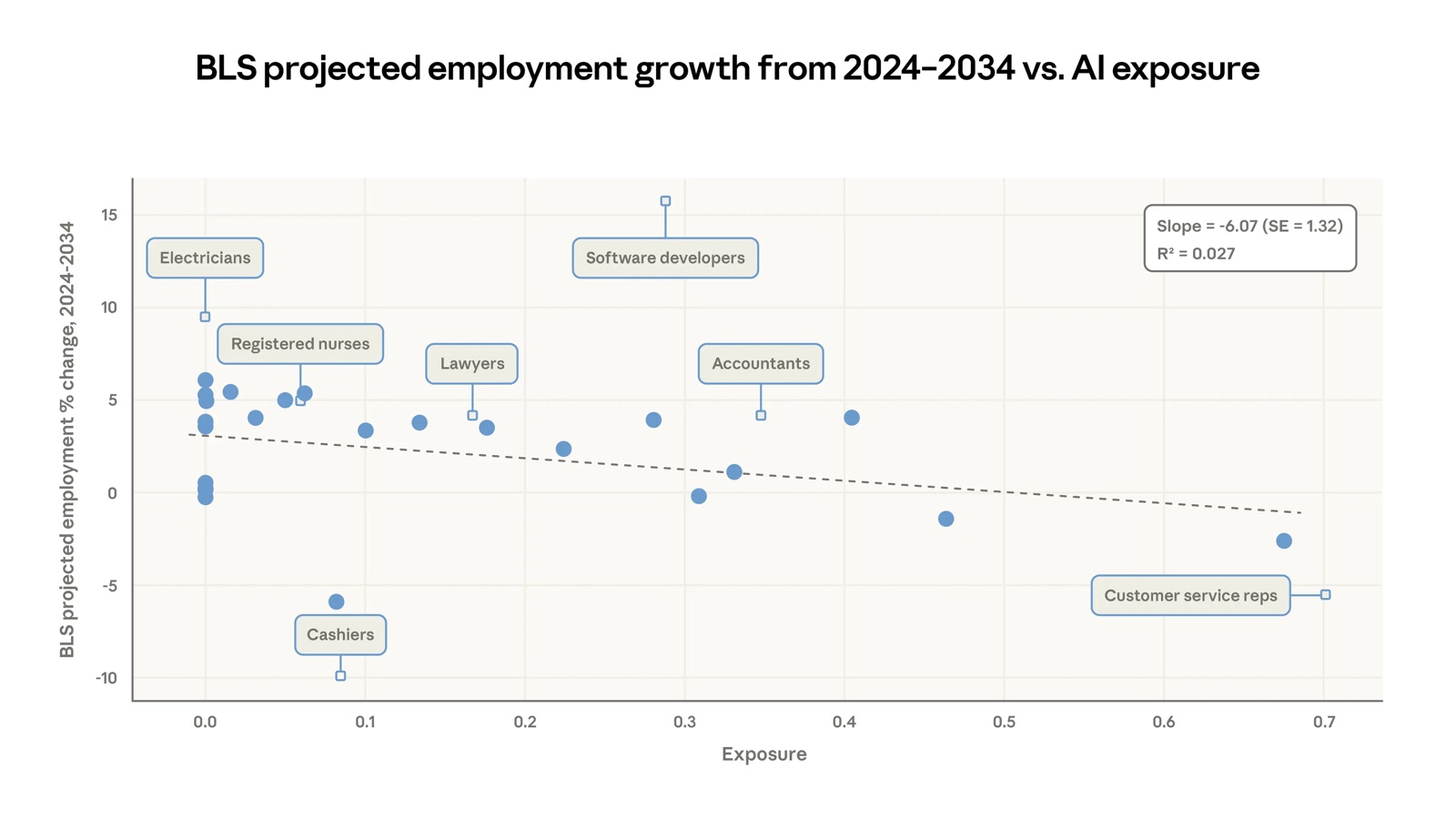
- Real usage predicts job growth; theory does not. For every 10 percentage points of observed AI coverage, an occupation's official 2024-2034 growth projection falls 0.6 points. Theoretical "could AI do this" scores show no such link. Watch what AI is used for, not what it could do.
- AI is far behind its own capability. In computer and maths work, AI could handle 94% of tasks, yet real usage covers 33%.
- Almost a third of work is untouched. About 30% of workers are in jobs with zero measured AI coverage, mostly hands-on roles.
- Not every graduate slump is AI. Unemployment among 20 to 24 year-old graduates rose in 2025, but it moved in step with 25 to 29 year-olds, pointing to a cooler job market rather than AI, according to the Yale Budget Lab.
Which Jobs Are Most Exposed to AI?
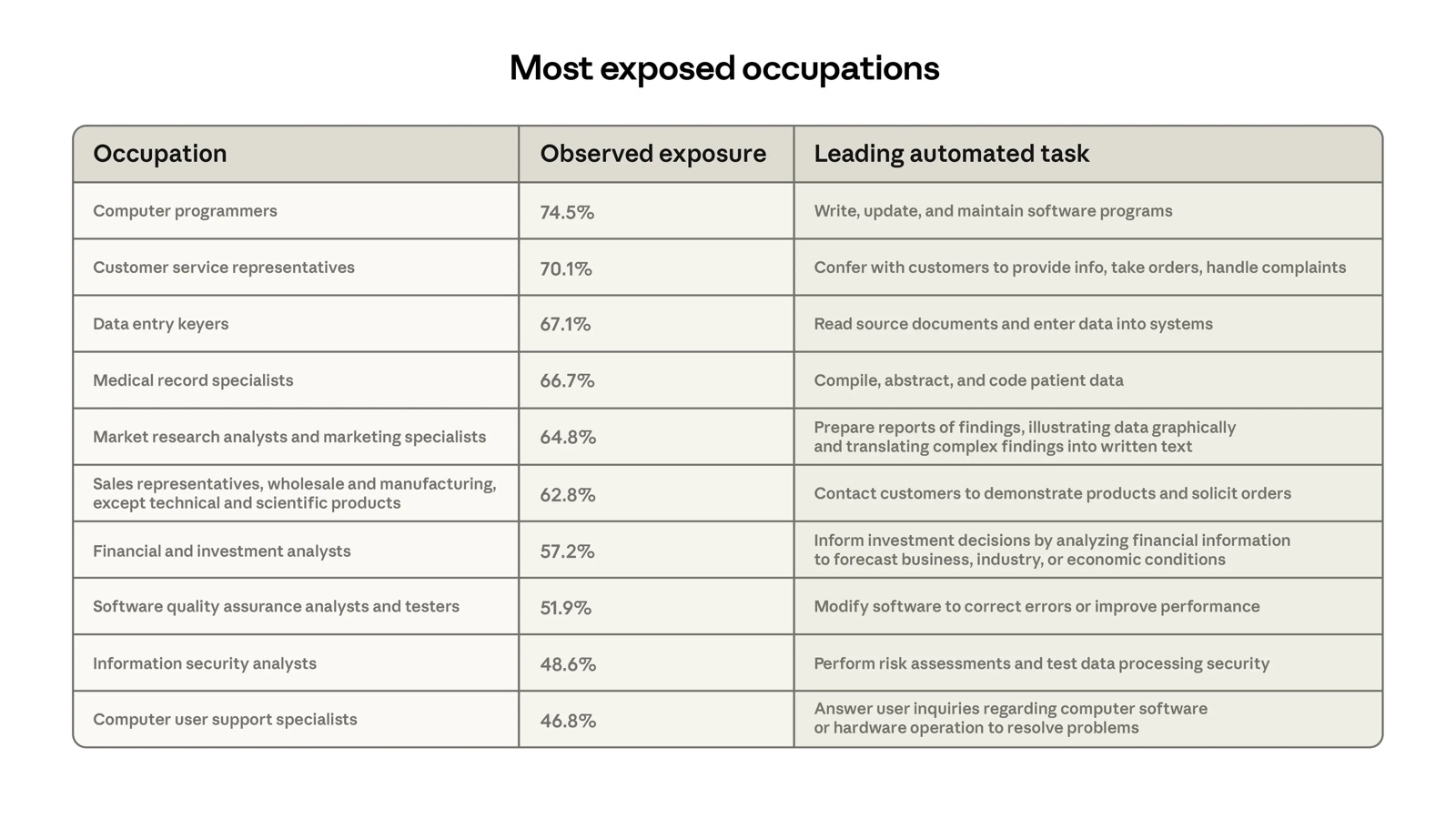
| Occupation | Tasks covered by real AI use |
|---|---|
| Computer programmers | 75% |
| Data entry keyers | 67% |
| Customer service representatives | 70% |
| Medical record specialists | 67% |
| Market research analysts and marketing specialists | 65% |
| Financial and investment analysts | 57% |
| Cooks, mechanics, lifeguards, bartenders | None measured |
Source: Anthropic, "Labor market impacts of AI" (March 2026).
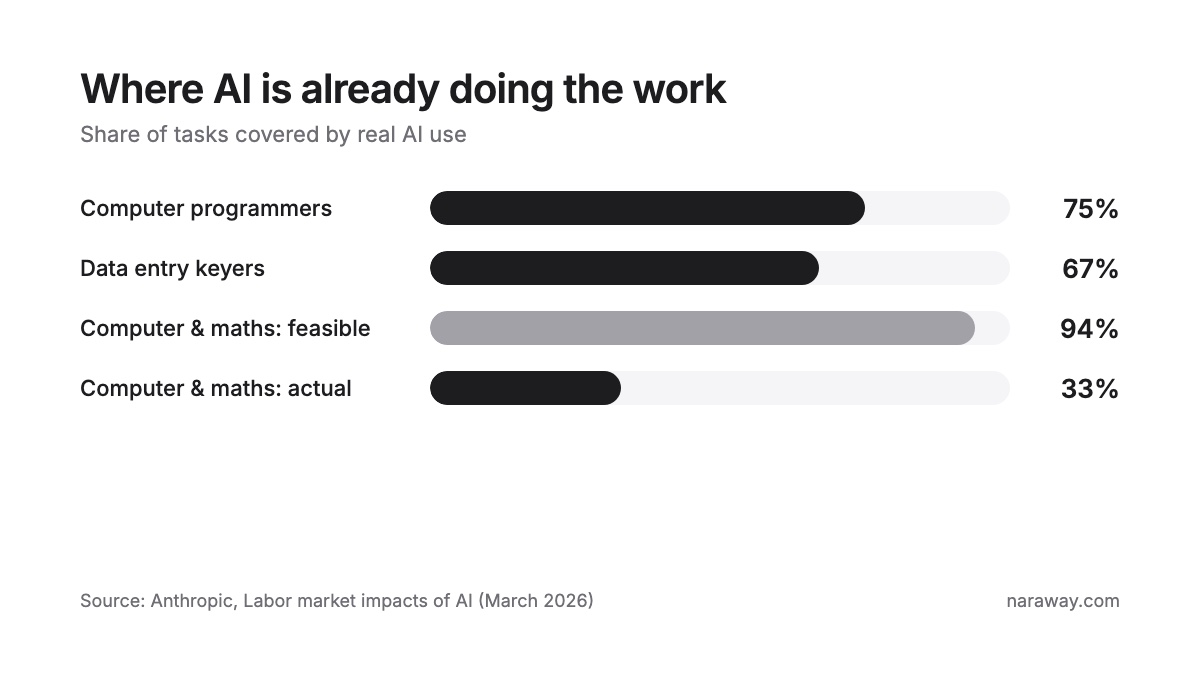
That 61-point gap is where the advantage sits. Companies that redesign workflows to close it move faster at lower cost, before competitors do. See how Naraway puts AI to work inside real workflows
AI Hiring in India: Demand Moves to AI Skills
India's live hiring data shows where the demand is going. Naukri's JobSpeak index rose 6% year on year in June 2026, with AI and machine-learning roles up 25%. In IT, Info Edge CEO Hitesh Oberoi noted that "even as IT hiring has moderated, AI hiring within the sector grew 16% YOY in June."
Source: Naukri JobSpeak (June 2026).
The Future of Work to 2030
The World Economic Forum expects about 170 million jobs to be created and 92 million displaced by 2030, a net gain of 78 million, with nearly 40% of required skills changing. The jobs will be there. The question is whether your people will have the skills they demand.
AI Workforce Planning: What Smart Employers Do Next
- Keep the entry door open. Cutting junior hiring saves money now and leaves a leadership gap in five years. Redesign junior roles around AI instead.
- Hire for what AI amplifies. Judgment, problem-solving, and directing AI tools now outweigh routine output. Our guide to skill-based hiring
- Plan by task, not by job title. Map which tasks AI handles in each role, then reshape the role around what remains.
- Track real usage. It predicts change better than theoretical exposure, so measure how your teams actually use AI.
- Reskill before you replace. With nearly 40% of skills shifting by 2030, training your team is faster and cheaper than rebuilding it.
Build a Team That Grows With AI
AI-ready roles, and the talent to fill them. Naraway's recruitment team helps growing companies hire for the next decade.
Contact UsHow We Compiled This
This analysis draws only on published research and official hiring data: Anthropic's labour-market study (March 2026), Stanford Digital Economy Lab's payroll research (August 2026 update), the Yale Budget Lab's analysis published with Brookings, the World Economic Forum's Future of Jobs Report 2025, and Naukri's JobSpeak index for June 2026. Figures are reported as published by each source, listed in full below.
The Bottom Line
AI is not emptying offices. It is narrowing the entry points into work, rewarding new skills, and leaving most of its potential unused. The employers who win this decade will act on the data, not the headlines: hire smarter, redesign roles, and put AI to work where it already can.
Sources
- Labor market impacts of AI: A new measure and early evidence, Anthropic (March 2026)
- Canaries in the Coal Mine? Recent Employment Effects of Artificial Intelligence (August 2026 update), Stanford Digital Economy Lab (August 2026)
- New data show no AI jobs apocalypse, for now, Brookings
- The Future of Jobs Report 2025, World Economic Forum (January 2025)
- Naukri JobSpeak: White-collar hiring grows 6% in June 2026, Naukri (July 2026)
Frequently Asked Questions
Is AI causing job losses in 2026?
Not at an economy-wide level. Research tracking US labour data finds no systematic rise in unemployment in AI-exposed jobs since late 2022. The measurable effect is on hiring: fewer early-career workers are being hired into AI-exposed roles.
Which jobs are most exposed to AI?
Roles built on text, data, and code. AI usage already covers 75% of computer programmers' tasks and 70% of customer service representatives' tasks, and 67% of data entry keyers' tasks. Hands-on roles such as cooks, mechanics, and bartenders show no measurable coverage.
Is AI reducing entry-level jobs?
In AI-exposed fields, yes. Workers aged 22 to 25 in the most exposed jobs stand 19% below where they would be had they kept pace with less-exposed peers, driven mainly by reduced hiring rather than layoffs.
How is AI changing hiring in India?
Demand is shifting to AI skills. Naukri's June 2026 data shows white-collar hiring up 6% year on year, AI and machine-learning roles up 25%, and AI hiring within the IT sector up 16%.
What should employers do about AI and hiring?
Keep hiring at the entry level but redesign those roles around AI, hire for the skills AI amplifies, plan workforce changes task by task, and deploy AI on the work it can already do.