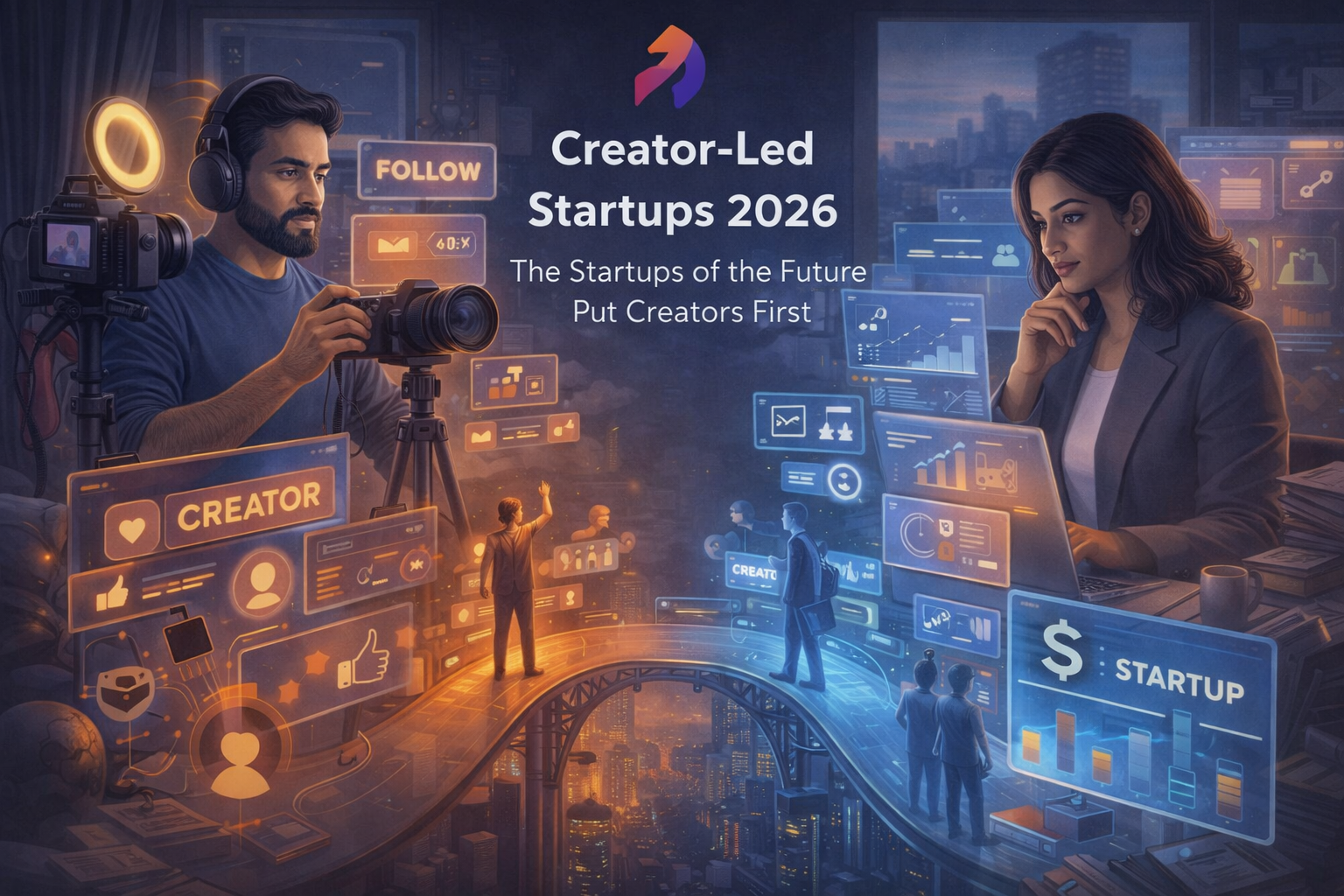
The 2026 Shift: Why Creators Are Becoming the New Founders
A fitness creator in Delhi with 200K Instagram followers told us last month: "I launched my nutrition coaching program. Sold out in 72 hours. ₹18 lakh revenue. But I have no company structure, no tax setup, no legal entity. I'm operating like a street vendor with a Mercedes."
This is 2026.
Creators have the distribution. They lack the execution.
And that gap is where the biggest business opportunity of this decade exists.
$2.5B
India creator economy 2025, projected $5B by 2027 (KPMG)
$350B
Consumer spending influenced by Indian creators (BCG 2025)
2-2.5M
Monetized content creators in India currently
$1T
Projected creator-influenced consumption India by 2030
What changed in 2026? Three forces converging:
Force 1: Platforms democratized distribution. TikTok, Instagram Reels, YouTube Shorts made it possible for anyone to reach millions. You don't need TV deals, publisher contracts, or production studios anymore. Phone + personality = audience.
Force 2: AI democratized production. Tools like CapCut, Canva, ChatGPT, Midjourney enable creators to produce content that previously required entire teams. High-quality output, minimal resources.
Force 3: Audiences trust creators more than brands. According to CNBC's 2025 analysis, 70% of brands now cite trust and credibility as top reason for choosing influencer partnerships over traditional advertising. Consumers believe creators, not corporate ads.
Result: Creators can launch businesses faster than traditional founders can acquire first 1,000 customers.
But here's the problem most miss: Having an audience ≠ having a business.
The Reversed Startup Model (This Changes Everything)
Traditional startups follow this painful path:
Build product → Find market → Acquire customers → Scale distribution → Establish brand → Finally profitable (maybe)
This takes 3-5 years. Burns millions in funding. 90% fail.
Creator-led startups reverse this entirely:
Audience already exists → Validate demand → Build product → Instant distribution → Brand from day one → Profitable month one (if executed correctly)
This is not incremental improvement. This is fundamental business model disruption.
| Factor |
Traditional Startup |
Creator-Led Startup |
| Customer Acquisition |
Spend 40-60% budget on ads, CAC $50-200 |
Built-in audience, CAC near-zero initially |
| Brand Building |
Takes 3-5 years, expensive campaigns |
Creator IS the brand, instant recognition |
| Product Validation |
Guess what market wants, build, hope |
ASK audience, pre-validate, then build |
| Funding Pitch |
Projections, TAM analysis, hopeful metrics |
Existing engagement data, proven conversion |
| Speed to Market |
12-18 months to launch with beta users |
Announce Monday, sell out Friday |
| Risk Profile |
High (product-market fit unknown) |
Lower (audience pre-validated demand) |
When Logan Paul and KSI launched Prime Hydration, they didn't need to "find customers." They had 45 million combined followers waiting. $1.2 billion in sales by 2023 (CNN). Traditional beverage startups take a decade to reach that scale.
When Ranveer Allahbadia (BeerBiceps) launched Level SuperMind mental wellness app, he announced to 10M+ YouTube subscribers. 1M downloads, funded by Peak XV Partners (Sequoia India). Zero traditional marketing spend needed.
This is the reversed model in action.
Critical 2026 Insight
Creators don't need to learn how to build audiences—they already have them. What they need to learn is how to build COMPANIES around those audiences. That's the missing skill. That's the gap Naraway fills. We're not teaching creators how to get followers. We're teaching them (and executing for them) how to turn followers into sustainable businesses with proper legal structure, tech infrastructure, operations, and teams.
The 2026 Creator Startup Blueprint (Step-by-Step)
Step 1: Audience → Demand Mapping
First, creators need to understand what their audience actually wants to buy (not what the creator wants to sell).
Tools in 2026 make this trivial: Poll your Instagram stories: "Would you pay ₹500/month for personalized meal plans?" Analyze YouTube comments: What problems do viewers keep asking about? Track DM themes: What services do people request repeatedly? Use AI sentiment analysis: Tools like BrandWatch scan all your content engagement to identify demand patterns.
Example: Fitness creator notices 40% of comments ask about "meal prep for working professionals." That's the product signal. Don't build generic fitness app—build meal prep subscription specifically for working professionals.
Validation before building = creator advantage. Traditional startups guess. Creators know.
Step 2: Brand Formation (Even Before Product)
Creators already operate as brands. Their personality, values, content style = instant brand identity.
But to transition from "influencer" to "company," need brand infrastructure: Brand name (can be different from creator handle—example: Emma Chamberlain → Chamberlain Coffee), Visual identity (logo, colors, typography—hire designer for ₹15K-50K), Brand voice documentation (how does brand communicate?—formal? playful? educational?), Legal protection (trademark registration—costs ₹8K-15K India, takes 12-18 months but START immediately).
This is where most creators skip steps. They launch products under their personal name without legal structure. Big mistake. When brand grows, you can't separate personal identity from business entity. Creates tax nightmares, partnership complications, exit difficulties.
Step 3: Instant Incorporation + Legal Setup
This is where Naraway enters (factual, not sales pitch):
Creator needs: Company registration (Private Limited recommended for scaling—allows funding, clear equity structure), Trademark filing (protect brand name, logo), Founder agreements (if multiple creators/co-founders), GST registration (mandatory if turnover >₹40L), Professional Tax, Shops & Establishment, Bank account (current account in company name), Accounting setup (books of accounts from day one—critical for tax compliance).
Timeline traditionally: 4-6 weeks if you know what you're doing. 3-6 months if you're figuring it out yourself.
With integrated platform: 10-14 days, everything handled, zero mistakes.
Cost of getting this wrong: Founders operating without legal structure face penalties, can't raise funding, have personal liability for business debts, create mess when trying to formalize later (untangling past transactions = nightmare).
Step 4: Tech Infrastructure Setup
Depending on business model, creators need: E-commerce platform (if selling physical products—Shopify, WooCommerce, or custom), Membership/Community platform (if subscription model—Circle, Mighty Networks, or custom app), Course delivery system (if educational content—Teachable, Thinkific, or custom LMS), Payment gateway integration (Razorpay, Stripe—compliance critical), Customer support system (Zendesk, Intercom, or WhatsApp Business API), Email marketing (for nurturing audience—ConvertKit, Mailchimp), Analytics (track conversions, revenue, churn—Mixpanel, Google Analytics).
Traditional approach: Creator tries to DIY or hires freelance developer on Upwork. Result: 6 months building, buggy product, no integration between systems, abandoned midway.
Integrated approach: Tech team assigned from day one, systems architected properly, launched in 4-6 weeks, everything works together, ongoing support included.
Step 5: Go-to-Market: Creator-Momentum Loops
This is where creator-led startups have unfair advantage.
Traditional GTM: Paid ads → Landing page → Conversion (expensive, low trust). Creator GTM: Content → Product mention → Community validation → Conversion (cheap, high trust).
Example: Fitness creator launching meal prep service doesn't buy Instagram ads. Instead: Publishes YouTube video: "I tried meal prepping for 30 days—here's what I learned." Naturally mentions: "I'm launching meal prep service because so many of you asked." Call-to-action: "Early access link in description." Result: 100K video views → 5K link clicks → 500 purchases (1% conversion) = ₹2.5L revenue with ZERO ad spend.
This is distribution-first GTM. Every piece of content doubles as marketing. Perpetual marketing engine.
Step 6: Hiring the Micro-Team
Creators don't need large teams initially. They need RIGHT roles: Operations Manager (handles fulfillment, customer service, logistics—frees creator to create), Creative Director (maintains content quality, edits videos, manages visual brand), Performance Marketer (runs paid ads when scaling beyond organic—Facebook, Google, influencer collabs), Tech Execution Team (maintains platform, fixes bugs, adds features).
Total team size: 3-5 people for ₹50L-1Cr annual revenue business.
Mistake: Hiring too fast. Creators think "I'm making money, I should hire." Then hire friends/fans who aren't qualified. Payroll becomes burden. Quality drops.
Smart approach: Hire fractional/contract first. Operations manager 20 hours/week = ₹30K/month vs full-time ₹60K. Test before committing.
Or partner with platform that provides execution team as integrated service (Naraway model—you get team without hiring headache).
Ready to Turn Your Audience Into a Business?
Most creators have distribution. Few have execution infrastructure. Naraway provides the legal + tech + operations + hiring systems creators need to build actual companies, not just influencer side hustles.
Talk to Creator Team
Book Strategy Call
Why Most Creator-Led Startups Fail (Despite Large Audiences)
The harsh truth: 90% of creators who try to launch businesses fail within first year.
Not because they lack audience. Because they lack execution.
Failure Pattern 1: The Execution Gap
Creators are great at: Content creation, storytelling, audience engagement, personal branding.
Creators are terrible at: Legal structuring, tech infrastructure, operations management, financial planning, team building, compliance.
Real disaster scenario we see constantly: Creator with 500K followers launches merchandise. Gets 10,000 orders first week. Amazing, right? Then: Can't fulfill orders (no logistics partner), payment gateway crashes (didn't stress-test), customers angry (no support team), GST notices arrive (no accounting), quality complaints (no QC), brand destroyed in 30 days.
Why? Because creator treated business launch like content launch—improvise, move fast, figure it out. But businesses need SYSTEMS.
Failure Pattern 2: One-Hit Wonder Syndrome
Many creators successfully launch one product (novelty effect—fans buy because it's creator's FIRST thing). Then can't repeat. Why? No product development process, no market research capability, no innovation pipeline, no brand positioning beyond "I'm launching something."
Result: Second product flops. Creator panics. Tries random launches. Brand dilutes. Audience loses trust.
Failure Pattern 3: Revenue Illusion
Creator sees: "100K followers × ₹500 product = ₹5 crore potential!" Reality: 2-5% conversion typical (industry standard). So 100K followers = 2K-5K buyers = ₹10L-25L revenue.
Minus: Product cost 40-60%, marketing (even organic needs some paid), logistics + platform fees 15-25%, returns + refunds 10-15%, team + overhead 20-30%. Actual profit: ₹2L-5L.
Not enough to quit day job. Many creators quit here: "Not worth the effort." Winners push through, improve margins, build systems, scale to ₹1Cr+ where economics work.
The Fatal Mistake Most Creators Make
They think: "I have followers, I'll launch something, money will come." Reality: Followers are POTENTIAL customers, not guaranteed customers. Converting audience to buyers requires: Product-market fit (are you solving real problem?), Quality execution (does product actually deliver value?), Trust preservation (one bad experience destroys years of audience building), Operational excellence (fulfillment, support, refunds handled smoothly). Most creators skip all of this. They launch products like they launch content—quick, improvised, hoping for viral moment. Businesses don't work that way. You need systems, processes, documentation, teams. That's the gap between influencer and entrepreneur.
Real Success Stories: Creator-Led Businesses That Scaled
Global Examples
MrBeast (Jimmy Donaldson) - YouTube's biggest creator turned multi-business empire: Feastables: Chocolate/snacks brand, hundreds of millions in revenue annually (Forbes), sold in Walmart, Target globally. Beast Burger: Ghost kitchen chain, 1,000+ locations US/Europe, estimated $100M+ annual revenue. Key lesson: Built actual companies with real operations, supply chains, quality control—not just "influencer products."
Logan Paul & KSI - Prime Hydration: Sports drink, $1.2 billion sales by 2023 (CNN). Combined 45M+ followers. Created scarcity (limited drops), retail partnerships (Walmart, Target, UK supermarkets). One of fastest-growing beverage brands ever. Execution excellence: Professional supply chain, manufacturing, distribution—not just influencer juice.
Emma Chamberlain - Chamberlain Coffee: D2C coffee brand, raised VC funding, now in Walmart/Target (TechCrunch). Sustainable sourcing, aesthetic packaging, lifestyle branding beyond coffee. Business model: Subscription + retail (diversified revenue).
Indian Examples
Ranveer Allahbadia (BeerBiceps): Level SuperMind: Mental wellness app, 1M+ downloads, funded by Peak XV Partners (Sequoia India). Monk Entertainment: Talent management + influencer marketing agency serving top brands. Used podcast/YouTube to validate ideas, then built execution teams to launch.
Bhuvan Bam (BB Ki Vines): Dhindora: India's first large-scale YouTube web series (creator-produced), 8 episodes, 100M+ views. BB Ki Vines Productions: Creating content for brands, OTT platforms. Built production infrastructure, hired teams, operates like media company.
PhysicsWallah (Alakh Pandey): Started with free YouTube physics lectures. Scaled through affordable subscriptions (₹500-₹5K). Became India's first profitable edtech unicorn ($100M funding, 2022). Built entire infrastructure—app, content delivery, doubt solving, tests. Not just videos.
Common pattern: None of these just "monetized their audience." They built COMPANIES with proper infrastructure, teams, systems, execution.
The Execution Gap Nobody Discusses
Here's what separates successful creator-led businesses from failed attempts:
Successful creators recognize: What they're good at (content, audience, brand), what they're NOT good at (systems, operations, legal, tech).
Then they plug the gap: Either hire teams (expensive, slow, management burden), or partner with execution platform (faster, integrated, less headache).
Failed creators think: "I built my audience myself, I can build my business myself."
This ego costs them everything. Building audience and building business are DIFFERENT skills.
Audience building: Creative, improvisational, personality-driven, viral moments. Business building: Systematic, process-driven, operationally rigorous, consistent execution.
You can be excellent creator and terrible entrepreneur. Most are.
India Creator Economy 2026: The Global Opportunity
India is uniquely positioned to lead global creator economy, not just participate:
1. Massive Creator Base: 2-2.5 million monetized creators currently (BCG). Total creator base 80-100 million (including hobbyists). Growing 22% annually.
2. Consumption Influence: Indian creators already influence $350 billion in consumer spending (BCG 2025). Projected to reach $1 trillion by 2030. That's more than many countries' entire GDP.
3. Government Backing: India announced $1 billion fund (₹8,545 crore) for creator ecosystem (WAVES Summit 2025, PM Modi). Building Indian Institute of Creative Technology (₹391 crore) for creative talent. Policy-level support = long-term commitment.
4. Platform Momentum: YouTube, Instagram Reels seeing billions of monthly views in India. Regional language content (Hindi, Tamil, Telugu, Bengali, Marathi) expanding reach beyond English metros. Tier 2/3 cities = untapped creator opportunity.
5. Brand Budget Shift: Indian brands now allocating 15%+ of digital budgets to creator partnerships (vs 5-8% globally). Influencer marketing projected ₹3,375 crore by 2026 (EY, Otbox Media). Money flowing into ecosystem.
6. Venture Capital Interest: VCs backing creator-led brands: Nish Hair (Shark Tank appearance), Level SuperMind (Peak XV/Sequoia), AI Fiesta (Dhruv Rathee's AI startup). Investors see distribution advantage = lower risk.
India's Creator Economy Unique Advantage
Unlike US/Europe where creator economy = sponsorships + ads, India trending toward creators building ACTUAL COMPANIES. Not just monetizing content—building D2C brands, SaaS tools, service businesses, media companies. This positions India as global leader in creator entrepreneurship, not just creation. 2026 opportunity: Creators with execution infrastructure can capture disproportionate market share before saturation. But window closing fast—every month, more creators trying to launch businesses. The ones who move now with proper execution support will dominate their niches.
How Naraway Powers Creator-Led Businesses (The Integrated Model)
We don't help creators get followers. We help creators turn followers into companies.
Here's what makes Naraway different:
Traditional approach: Creator cobbles together: Lawyer for incorporation (₹25K-50K), accountant for GST/taxes (₹15K-30K/year), freelance developer for website (₹1L-3L), marketing agency for ads (₹50K-2L/month), recruitment platform for hiring (₹30K-50K per hire).
Result: 5 vendors, 5 conversations, nothing integrated, gaps everywhere, expensive.
Naraway integrated approach: Legal: Company registration, trademarks, contracts, compliance—one platform. Tech: Website/app development, payment integration, hosting, maintenance—one team. Marketing: GTM strategy, content amplification, paid media, analytics—one system. Hiring: Operations manager, creative team, tech support—one recruitment process. Execution: Everything works together, no gaps, no vendor management headache.
What We Actually Build for Creators:
Phase 1: Foundation (Weeks 1-2): Company incorporation (Pvt Ltd structure), trademark filing (protect brand), bank account setup, GST + professional tax registration, accounting system implementation.
Phase 2: Tech Infrastructure (Weeks 3-6): E-commerce/membership platform (depending on model), payment gateway integration, customer database + CRM, email marketing automation, analytics dashboards.
Phase 3: Go-to-Market (Weeks 7-8): Content-to-commerce funnel design, launch campaign strategy, conversion tracking setup, customer support system.
Phase 4: Team & Operations (Ongoing): Hire operations manager, onboard creative support, implement fulfillment processes, ongoing compliance management.
Timeline: 6-8 weeks from "I have an idea" to "I'm making revenue legally and systematically."
This is execution infrastructure. This is what separates influencers from entrepreneurs.
Our Philosophy:
Creators should focus on what only they can do: Create content, engage audience, validate products, be brand face. Everything else—legal, tech, operations, hiring—should be handled by execution partner. That's Naraway.
We're not selling services. We're building companies.
Frequently Asked Questions
What is a creator-led startup and how is it different from traditional startups?
A creator-led startup is fundamentally different from traditional startups in its core DNA. Traditional startups follow the classic model: build product → find market → acquire customers → scale distribution. This is expensive, risky, and takes years. Creator-led startups reverse this entirely: audience already exists → validate demand → build product → instant distribution → scale. Key differences: (1) Distribution advantage: Traditional startups spend 40-60% of funding on customer acquisition. Creator-led startups have built-in audience (followers who trust them), making CAC near-zero initially. Example: When Logan Paul launched Prime Hydration, he didn't need to "find" customers—20M+ followers were already waiting. (2) Brand from day one: Traditional startups build brand over years. Creators ARE the brand already. Their personality, values, content style = instant brand identity. (3) Demand validation pre-launch: Traditional founders guess what market wants. Creators ASK their audience, run polls, test concepts via content before building anything. (4) Funding dynamics: Traditional startups pitch VCs with projections. Creator-led startups show VCs existing engagement metrics, conversion data from merchandise/courses, proof of audience willingness to pay. Less risky for investors. (5) Speed to market: Traditional startup: 12-18 months to launch with beta users. Creator startup: Announce product Monday, sell out by Friday (if executed correctly). Real example: Ranveer Allahbadia (BeerBiceps) launched Level SuperMind mental wellness app. He didn't need traditional marketing—his 10M+ YouTube subscribers were built-in distribution. App crossed 1M downloads, raised funding from Peak XV Partners (Sequoia India). However, big caveat: Creators have distribution but often LACK execution systems (legal structure, tech infrastructure, operations, hiring). That's the gap where most fail. They can sell products but can't build companies. Successful creator-led startups solve this by partnering with execution platforms (legal + tech + marketing + recruitment integrated). That's what separates influencers who launch one product from creators who build actual companies. Bottom line: Creator-led startups flip the startup playbook. Instead of "build it and they will come," it's "they're already here, what should we build?"
Why do most creator-led startups fail despite having large audiences?
Large audience ≠ successful business. This is the brutal reality killing creator-led startups. Here's why they fail: FAILURE POINT 1: EXECUTION GAP - Creators excel at content, storytelling, engagement. They do NOT excel at: Company incorporation + legal structure, Product development + tech infrastructure, Operations management + supply chain, Financial planning + compliance, Team building + HR systems. Real disaster scenario: Creator with 500K followers launches merchandise. Gets 10K orders first week (amazing!). Then: Can't fulfill orders (no logistics system), Payment gateway crashes (no tech backup), Customers angry (no customer service team), GST notices arrive (no accounting setup), Quality complaints (no QC process). Brand destroyed in 30 days. This happens because creators treat business like content—improvise, move fast, figure it out. But companies need SYSTEMS. FAILURE POINT 2: ONE-HIT WONDER SYNDROME - Many creators launch one product successfully, then can't repeat. Why? First launch has "novelty effect"—fans buy because it's the creator's FIRST thing. Second product? Audience expects same excitement but creator hasn't built: Product development process, Market research capability, Innovation pipeline, Brand positioning beyond "I'm launching something". Result: Second product flops. Creator panics. Tries random things. Brand dilutes. FAILURE POINT 3: REVENUE ILLUSION - Creator sees big numbers: "100K followers × ₹500 product = ₹5 crore potential!" Reality: 2-5% conversion rate typical. So 100K followers = 2K-5K buyers = ₹10L-25L revenue. Minus: Product cost (40-60% of revenue), Marketing (even with organic reach, need paid ads for scale), Logistics + platform fees (15-25%), Returns + refunds (10-15%), Team + overhead (20-30%). Actual profit: ₹2L-5L. Not enough to build company. Many creators quit here because "not worth the effort." Winners push through, improve margins, build systems. FAILURE POINT 4: TALENT MISMATCH - Creators hire wrong people: They hire fans (enthusiastic but unskilled), They hire friends (comfortable but unqualified), They hire expensive "experts" who don't understand creator economy. What they actually need: Operations manager who can build systems, Tech partner who executes fast (not perfect), Performance marketer who understands creator funnels, Legal + compliance advisor who prevents disasters. Hiring wrong team = wasted cash + delayed execution + missed opportunities. FAILURE POINT 5: NO BUSINESS MODEL - Creators launch products without understanding: Unit economics (what's my margin per product?), CAC payback period (how long to recover customer acquisition cost?), LTV (what's customer worth over lifetime?), Cash flow (when do I actually get paid vs when do I pay suppliers?). They operate on "vibes" not data. When cash runs out, they're shocked. THE SOLUTION PATTERN: Successful creator-led startups do this: (1) Acknowledge what they're good at (content, audience, brand) and what they're NOT (systems, operations, legal). (2) Partner with execution platform that handles: Legal setup (incorporation, trademarks, contracts), Tech infrastructure (website, app, payment systems), Operations (logistics, customer service, fulfillment), Hiring (source right talent, not random applicants), Compliance (taxes, filings, regulatory). (3) Focus on what only they can do: Create content, engage audience, validate products, be the brand face. (4) Let execution partner handle everything else. This is the Naraway model: Creators bring distribution. Naraway builds the company infrastructure. Together = scalable business. Example: Fitness creator with 200K Instagram followers wants to launch nutrition app. Solo approach: Spends 8 months trying to find tech team, budget ₹15L for development, launches buggy app, no payment gateway integration, overwhelmed by compliance. Quits. Integrated approach (with execution partner): Legal entity setup in 2 weeks, Tech team assigned immediately (app ready in 6 weeks), Payment + logistics integrated, Compliance handled proactively, Creator focuses on content + community. Launches successfully. Bottom line: Creator-led startups fail not because of bad ideas or small audiences. They fail because creators don't have execution systems. The winners are those who recognize this gap early and plug it with the right partner.
What is the India creator economy market size and growth potential in 2026?
India's creator economy is exploding with numbers that demand attention. Current market size (2025): India creator economy worth $2.5 billion, projected to exceed $5 billion by 2027 (KPMG, Redseer). Direct revenue from creator ecosystem expected to grow from $20-25 billion (FY 2024) to over $100 billion by 2030 (BCG). Influencer marketing alone projected to reach ₹3,375 crore by 2026, growing at 25% CAGR (EY, Otbox Media). Creator base: 2-2.5 million monetized content creators in India currently (BCG), influencing over $350 billion in consumer spending. Total creator base (including non-monetized): 80-100 million according to social platforms. Projected to drive $1 trillion in "creator-influenced" consumption by 2030 (BCG). Government backing: India announced $1 billion fund (₹8,545 crore) dedicated to fostering content creators and digital innovation, showcasing policy-level support for creator economy growth (WAVES Summit 2025, PM Modi announcement). Building Indian Institute of Creative Technology (IICT) with ₹391 crore to train talent in digital creative fields. Platform momentum: YouTube, Instagram Reels, Moj, ShareChat, Josh driving consumption. Short-form video content seeing billions of views monthly in India. 70% of brands now cite trust and credibility as top reason for choosing influencer partnerships over traditional advertising. Monetization reality check: However, only 8-10% of Indian creators earn consistently (BCG). 73% of creators work less than 10 hours per week on content. Only 30% make enough from brand deals to work full-time. This massive gap between creator base and monetization shows HUGE opportunity for platforms enabling creator businesses. Revenue distribution: 68.8% of global creators rely on brand deals as primary income. 7.3% earn mainly from ad revenue. Rest from subscriptions, merchandise, courses, community memberships. India trending toward diversified monetization (subscriptions + products + community). Why India specifically is positioned for creator economy explosion: (1) Demographics: 500 million+ active social media users, 65% population under 35 years old (young, digital-native audience). (2) Affordable internet: Among cheapest data costs globally, enabling consumption + creation at scale. (3) Regional language boom: Creator content in Hindi, Tamil, Telugu, Bengali, Marathi expanding reach beyond English-speaking metro audiences. Vernacular creators seeing highest growth rates. (4) Mobile-first infrastructure: Smartphone penetration enables high-quality content creation from anywhere (no expensive equipment needed). (5) Cultural shift: Content creation now seen as legitimate career path (not just hobby). Parents accepting "YouTuber" as viable profession. (6) Platform innovation: Indian platforms (Moj, Josh, ShareChat) competing with global ones, creating more monetization opportunities for local creators. (7) Brand budget shift: Indian brands allocating 15%+ of digital marketing budgets to creator partnerships (vs 5-8% globally). Sector-specific opportunities: Education creators (like PhysicsWallah): Massive due to India's exam culture + edtech boom. Fitness/wellness: Growing middle class investing in health. Finance/investment: Young audience wanting financial literacy. Entertainment/comedy: Always popular, now monetizable. Regional content: Tier 2/3 cities consuming content in local languages. What this means for creator-led startups in 2026: Market timing is PERFECT. Creator base large, monetization still low (room to grow). Brand budgets shifting from TV to digital creators. Government actively supporting ecosystem. Technology (AI tools, no-code platforms) making it easier for creators to launch businesses without technical skills. Venture capital flowing into creator-led brands (investors seeing proven distribution advantage). Critical insight: India becoming global leader in creator economy not just by creator count but by CREATOR-LED BUSINESSES. Unlike US/Europe where creator economy = sponsorships, India trending toward creators building actual companies (D2C brands, SaaS tools, service businesses). This positions India uniquely for next wave: creators as entrepreneurs, not just influencers. Naraway's role in this ecosystem: As execution partner enabling creators to convert audience into businesses. Legal + tech + marketing + hiring integrated platform specifically designed for creator-led startups. Because the gap isn't creation (creators are great at that). Gap is EXECUTION. Bottom line: India creator economy in 2026 = $2.5B market growing to $5B+ by 2027, with $1T consumption influence by 2030. But only those who can execute beyond content will capture this opportunity.
What are real examples of successful creator-led businesses globally and in India?
Successful creator-led businesses prove the model works at massive scale when execution meets distribution. Here are real examples: GLOBAL EXAMPLES: (1) MrBeast (Jimmy Donaldson) - YouTube's biggest creator turned multi-business empire: Feastables: Chocolate and snacks brand generating hundreds of millions in revenue annually (Forbes). Sold in Walmart, Target, major retailers globally. Beast Burger: Ghost kitchen restaurant chain operating in 1,000+ locations across US/Europe. Estimated $100M+ annual revenue. MrBeast Burger app: Custom ordering platform. Approach: Used YouTube videos as product launches. Each video = marketing campaign reaching 100M+ people. Built supply chain, logistics, quality control systems (execution infrastructure most creators skip). Key insight: MrBeast didn't just "influencer market" products. He built actual companies with real operations, distribution networks, and business systems. (2) Logan Paul & KSI - Prime Hydration: Sports drink brand crossed $1.2 billion in sales by 2023 (CNN), continues expanding globally. Strategy: Combined audiences (20M+ Logan, 25M+ KSI), created scarcity (limited drops), retail partnerships (Walmart, Target, Asda UK). Result: One of fastest-growing beverage brands in history, outpacing established competitors. Execution excellence: Professional supply chain, quality manufacturing, distribution deals—not just "influencer juice." (3) Emma Chamberlain - Chamberlain Coffee: D2C coffee brand, raised VC funding, now sold in Walmart and Target (TechCrunch). Unique positioning: Sustainable sourcing, aesthetic packaging, lifestyle branding beyond just coffee. Business model: Subscription + retail, diversified revenue. (4) Alisha Marie & Remi Cruz - Parallel Apparel: Creator-led sustainable fashion brand building on 20M+ combined followers. Focus: Ethical manufacturing, community-driven design (fans vote on products). (5) Huda Kattan - Huda Beauty: Beauty influencer turned founder. Brand valued at $1.2 billion+. Sold in Sephora globally. Started as beauty blogger, built massive Instagram following, launched products, scaled into global beauty empire. INDIAN EXAMPLES: (1) Ranveer Allahbadia (BeerBiceps) - Multi-business creator: Level SuperMind: Mental wellness app, crossed 1M+ downloads, raised funding from Peak XV Partners (Sequoia India). Addresses mental health using creator's authority in personal development space. Monk Entertainment: Talent management and influencer marketing agency working with top Indian brands. Revenue from both talent fees + brand partnerships. Approach: Used podcast/YouTube audience to validate product ideas, then built execution teams to launch. (2) Tanmay Bhat (Comedian/Content Creator) - All Things Small: Content studio focused on documentaries and factual storytelling. Raised VC funding, works with Netflix, Audible, other premium platforms. Insight: Moved beyond comedy content into serious media production business. (3) Bhuvan Bam (BB Ki Vines) - Dhindora: India's first large-scale YouTube web series fully produced by creator. 8 episodes, cinematic production quality, 100M+ total views. BB Ki Vines Productions: Production house creating content for brands, OTT platforms. Exploring brand collaborations, merchandising, OTT expansion. Strategy: Built production infrastructure, hired professional teams, operates like media company not just solo creator. (4) Kusha Kapila (Digital Personality) - UnderNeat: Fashion venture leveraging Kusha's massive Instagram following in fashion/lifestyle space. Moved from brand sponsorships to owning brand + margins. (5) Parul Gulati (Influencer) - Nish Hair: Hair extensions brand gained national visibility through Shark Tank India appearance (Season 1). Used influencer credibility to launch D2C brand, then scaled through retail + online. (6) PhysicsWallah (Alakh Pandey) - EdTech Unicorn: Started with free YouTube physics lectures. Scaled through affordable course subscriptions (₹500-₹5K). 2022: Became India's first profitable edtech unicorn after $100M funding round. Millions of paying students. Execution: Built entire edtech infrastructure—app, content delivery, doubt solving, test platform. Not just videos. (7) Satvic Movement (Subah Saraf) - Health/Wellness Brand: YouTube channel on natural health, Ayurveda, plant-based living. Premium memberships: Exclusive health programs, workshops, recipes. Community-driven monetization = engaged, loyal audience willing to pay. COMMON PATTERNS IN SUCCESSFUL CREATOR-LED BUSINESSES: (1) Don't just monetize audience—build actual businesses (products, platforms, services with real operations). (2) Invest in execution infrastructure (legal, tech, logistics, teams). (3) Diversify revenue (not just ads or sponsorships—subscriptions, products, communities). (4) Maintain authenticity while scaling (audience trusts them, they protect that trust with quality). (5) Use content as perpetual marketing engine (every video/post = free marketing). (6) Partner with execution specialists (most don't do everything solo—they build teams or partner with platforms handling operations/legal/tech). Why these succeeded while others failed: They recognized creator economy evolution: Phase 1 (2015-2020): Monetize via ads + sponsorships. Phase 2 (2020-2025): Launch products but stay influencer-focused. Phase 3 (2025-2030): Build actual companies with creator as brand foundation but professional execution infrastructure. Winners are in Phase 3. Losers stuck in Phase 1-2. NARAWAY'S POSITION: We enable Phase 3 transition. Creators bring distribution (audience, content, brand). Naraway brings execution (legal setup, tech infrastructure, operations, hiring, compliance). Together = creator-led businesses that scale like real companies, not just influencer side hustles. Bottom line: Creator-led businesses work at billion-dollar scale when distribution meets execution. The examples above prove it globally and in India.
Naraway - Global IT, E-Commerce, Web Development, AI Integration & Digital Marketing Services Worldwide
Complete Global Coverage - 700+ Cities in 195 Countries
Naraway provides professional IT development, custom e-commerce platforms, AI integration, web development, digital marketing, recruitment services, and complete business solutions to startups, enterprises, SMEs, and entrepreneurs worldwide. We serve clients in 700+ cities across 195 countries with 24/7 support.
Indian Cities - Complete Coverage (350+ Locations)
Metro & Tier-1 Cities
Mumbai, Delhi, New Delhi, Bangalore, Bengaluru, Noida, Greater Noida, Pune, Gurgaon, Gurugram, Hyderabad, Chennai, Kolkata, Ahmedabad, Jaipur, Surat, Lucknow, Kanpur, Nagpur, Indore, Thane, Bhopal, Visakhapatnam, Vizag, Patna, Vadodara, Ghaziabad, Ludhiana, Agra, Nashik, Faridabad, Meerut, Rajkot, Varanasi, Navi Mumbai, Kochi, Coimbatore, Vijayawada, Madurai, Raipur, Kota, Chandigarh, Guwahati, Mysore, Mysuru
Tier-2 & Tier-3 Cities - Maharashtra
Aurangabad, Solapur, Amravati, Kolhapur, Sangli, Jalgaon, Akola, Latur, Dhule, Ahmednagar, Chandrapur, Parbhani, Ichalkaranji, Jalna, Bhiwandi, Panvel, Ulhasnagar, Malegaon, Satara, Osmanabad
Tier-2 & Tier-3 Cities - Karnataka
Mangalore, Hubli, Belgaum, Belagavi, Gulbarga, Kalaburagi, Bellary, Ballari, Davangere, Shimoga, Shivamogga, Tumkur, Tumakuru, Raichur, Bijapur, Vijayapura, Hospet, Gadag, Udupi, Hassan, Mandya, Chitradurga
Tier-2 & Tier-3 Cities - Tamil Nadu
Tiruchirappalli, Trichy, Salem, Tirunelveli, Tiruppur, Erode, Vellore, Thoothukudi, Tuticorin, Dindigul, Thanjavur, Ranipet, Sivakasi, Karur, Nagercoil, Kanchipuram, Kumbakonam, Hosur, Ambur, Tiruvannamalai, Pollachi, Rajapalayam
Tier-2 & Tier-3 Cities - Kerala
Thiruvananthapuram, Trivandrum, Kozhikode, Calicut, Thrissur, Kollam, Palakkad, Alappuzha, Malappuram, Kannur, Kasaragod, Kottayam, Ernakulam, Wayanad
Tier-2 & Tier-3 Cities - Andhra Pradesh & Telangana
Guntur, Nellore, Kurnool, Rajahmundry, Kadapa, Kakinada, Tirupati, Anantapur, Warangal, Nizamabad, Karimnagar, Khammam, Nalgonda, Mahbubnagar, Eluru, Ongole
Tier-2 & Tier-3 Cities - Gujarat
Bhavnagar, Jamnagar, Junagadh, Gandhidham, Anand, Navsari, Morbi, Nadiad, Surendranagar, Bharuch, Mehsana, Gandhinagar, Valsad, Vapi, Porbandar, Palanpur, Godhra
Tier-2 & Tier-3 Cities - Rajasthan
Jodhpur, Udaipur, Ajmer, Bikaner, Alwar, Bharatpur, Sikar, Bhilwara, Pali, Tonk, Kishangarh, Beawar, Hanumangarh
Tier-2 & Tier-3 Cities - Uttar Pradesh
Allahabad, Prayagraj, Bareilly, Aligarh, Moradabad, Saharanpur, Gorakhpur, Firozabad, Jhansi, Muzaffarnagar, Mathura, Rampur, Shahjahanpur, Farrukhabad, Hapur, Etawah, Mirzapur, Bulandshahr, Sambhal, Amroha, Hardoi, Fatehpur, Raebareli, Unnao, Sitapur, Bahraich
Tier-2 & Tier-3 Cities - Madhya Pradesh
Jabalpur, Gwalior, Ujjain, Sagar, Dewas, Satna, Ratlam, Rewa, Murwara, Katni, Singrauli, Burhanpur, Khandwa, Morena, Bhind
Tier-2 & Tier-3 Cities - Punjab & Haryana
Amritsar, Jalandhar, Patiala, Bathinda, Mohali, Pathankot, Hoshiarpur, Batala, Moga, Faridkot, Kapurthala, Panipat, Ambala, Yamunanagar, Rohtak, Hisar, Karnal, Sonipat, Panchkula, Bhiwani, Sirsa, Bahadurgarh
Tier-2 & Tier-3 Cities - Bihar & Jharkhand
Gaya, Bhagalpur, Muzaffarpur, Darbhanga, Arrah, Begusarai, Katihar, Munger, Chhapra, Purnia, Saharsa, Sasaram, Hajipur, Jamshedpur, Dhanbad, Bokaro, Deoghar, Hazaribagh, Giridih, Ramgarh
Tier-2 & Tier-3 Cities - West Bengal
Howrah, Durgapur, Asansol, Siliguri, Bardhaman, Barddhaman, Malda, Baharampur, Habra, Kharagpur, Darjeeling, Jalpaiguri, Raiganj
Tier-2 & Tier-3 Cities - Odisha
Bhubaneswar, Cuttack, Rourkela, Brahmapur, Berhampur, Sambalpur, Puri, Balasore, Bhadrak
Tier-2 & Tier-3 Cities - Chhattisgarh
Bhilai, Bilaspur, Korba, Durg, Rajnandgaon, Raigarh
Tier-2 & Tier-3 Cities - Uttarakhand
Dehradun, Haridwar, Roorkee, Haldwani, Rudrapur, Kashipur, Rishikesh, Nainital
Tier-2 & Tier-3 Cities - Himachal Pradesh
Shimla, Manali, Dharamshala, Solan, Mandi, Kullu
Tier-2 & Tier-3 Cities - Jammu & Kashmir
Srinagar, Jammu, Anantnag, Baramulla, Udhampur, Kathua
Tier-2 & Tier-3 Cities - Northeast States
Dibrugarh, Jorhat, Nagaon, Tinsukia, Silchar, Imphal, Aizawl, Agartala, Shillong, Kohima, Itanagar, Gangtok
Tier-2 & Tier-3 Cities - Goa & Other UTs
Panaji, Margao, Vasco da Gama, Mapusa, Ponda, Puducherry, Pondicherry, Port Blair, Kavaratti, Daman, Diu, Silvassa
International Cities - Comprehensive Global Coverage (500+ Cities)
United States (100+ cities)
Washington DC, New York, New York City, NYC, Manhattan, Brooklyn, Queens, Los Angeles, San Francisco, Silicon Valley, Chicago, Boston, Seattle, Austin, Miami, Denver, Atlanta, Dallas, Houston, Phoenix, Philadelphia, San Diego, San Jose, Portland, Las Vegas, Detroit, Minneapolis, Tampa, Orlando, Charlotte, Nashville, Raleigh, Columbus, Indianapolis, Jacksonville, Fort Worth, Sacramento, Kansas City, Milwaukee, Baltimore, Memphis, Louisville, Richmond, Oklahoma City, Salt Lake City, Buffalo, Tucson, Fresno, Albuquerque, Omaha, Honolulu, Anchorage, Newark, Jersey City, Pittsburgh, Cincinnati, Cleveland, St. Louis, New Orleans, Birmingham, Boise, Spokane, Des Moines, Madison, Rochester, Providence, Hartford, and 50+ more US cities
Canada (15+ cities)
Ottawa, Toronto, Vancouver, Montreal, Calgary, Edmonton, Winnipeg, Quebec City, Hamilton, Kitchener, Victoria, Halifax, Mississauga, Brampton, Surrey
United Kingdom (25+ cities)
London, Manchester, Birmingham, Edinburgh, Leeds, Glasgow, Liverpool, Bristol, Sheffield, Newcastle, Nottingham, Leicester, Cardiff, Belfast, Southampton, Cambridge, Oxford, Brighton, Aberdeen, Reading, and more UK cities
United Arab Emirates (8 cities)
Dubai, Abu Dhabi, Sharjah, Ajman, Ras Al Khaimah, Fujairah, Umm Al Quwain, Al Ain
Saudi Arabia (12+ cities)
Riyadh, Jeddah, Dammam, Mecca, Medina, Khobar, Dhahran, Jubail, Tabuk, Buraidah, Yanbu, Abha
Europe (150+ cities)
Paris, Berlin, Munich, Frankfurt, Hamburg, Amsterdam, Rotterdam, Madrid, Barcelona, Rome, Milan, Zurich, Geneva, Brussels, Vienna, Stockholm, Copenhagen, Oslo, Helsinki, Dublin, Lisbon, Prague, Warsaw, Budapest, Athens, Bucharest, Kyiv, Moscow, Saint Petersburg, and 120+ more European cities across all EU and non-EU countries
Middle East & GCC (50+ cities)
Dubai, Abu Dhabi, Riyadh, Jeddah, Doha, Kuwait City, Manama, Muscat, Tel Aviv, Jerusalem, Amman, Beirut, Baghdad, Tehran, and 35+ more Middle Eastern cities
Asia-Pacific (150+ cities)
Singapore, Shanghai, Beijing, Shenzhen, Tokyo, Osaka, Seoul, Busan, Bangkok, Kuala Lumpur, Jakarta, Manila, Sydney, Melbourne, Hong Kong, Taipei, Hanoi, Ho Chi Minh City, and 130+ more APAC cities
Africa (70+ cities)
Johannesburg, Cape Town, Cairo, Lagos, Nairobi, Casablanca, Addis Ababa, Accra, Dar es Salaam, and 60+ more African cities
Latin America (60+ cities)
São Paulo, Rio de Janeiro, Buenos Aires, Mexico City, Bogotá, Santiago, Lima, Caracas, and 50+ more Latin American cities
Complete Country Coverage (195 Countries)
Afghanistan, Albania, Algeria, Andorra, Angola, Antigua and Barbuda, Argentina, Armenia, Australia, Austria, Azerbaijan, Bahamas, Bahrain, Bangladesh, Barbados, Belarus, Belgium, Belize, Benin, Bhutan, Bolivia, Bosnia and Herzegovina, Botswana, Brazil, Brunei, Bulgaria, Burkina Faso, Burundi, Cambodia, Cameroon, Canada, Cape Verde, Central African Republic, Chad, Chile, China, Colombia, Comoros, Congo, Costa Rica, Croatia, Cuba, Cyprus, Czech Republic, Denmark, Djibouti, Dominica, Dominican Republic, Ecuador, Egypt, El Salvador, Equatorial Guinea, Eritrea, Estonia, Eswatini, Ethiopia, Fiji, Finland, France, Gabon, Gambia, Georgia, Germany, Ghana, Greece, Grenada, Guatemala, Guinea, Guinea-Bissau, Guyana, Haiti, Honduras, Hungary, Iceland, India, Indonesia, Iran, Iraq, Ireland, Israel, Italy, Ivory Coast, Jamaica, Japan, Jordan, Kazakhstan, Kenya, Kiribati, Kosovo, Kuwait, Kyrgyzstan, Laos, Latvia, Lebanon, Lesotho, Liberia, Libya, Liechtenstein, Lithuania, Luxembourg, Madagascar, Malawi, Malaysia, Maldives, Mali, Malta, Marshall Islands, Mauritania, Mauritius, Mexico, Micronesia, Moldova, Monaco, Mongolia, Montenegro, Morocco, Mozambique, Myanmar, Namibia, Nauru, Nepal, Netherlands, New Zealand, Nicaragua, Niger, Nigeria, North Korea, North Macedonia, Norway, Oman, Pakistan, Palau, Palestine, Panama, Papua New Guinea, Paraguay, Peru, Philippines, Poland, Portugal, Qatar, Romania, Russia, Rwanda, Saint Kitts and Nevis, Saint Lucia, Samoa, San Marino, Saudi Arabia, Senegal, Serbia, Seychelles, Sierra Leone, Singapore, Slovakia, Slovenia, Solomon Islands, Somalia, South Africa, South Korea, South Sudan, Spain, Sri Lanka, Sudan, Suriname, Sweden, Switzerland, Syria, Taiwan, Tajikistan, Tanzania, Thailand, Timor-Leste, Togo, Tonga, Trinidad and Tobago, Tunisia, Turkey, Turkmenistan, Tuvalu, Uganda, Ukraine, United Arab Emirates, United Kingdom, United States, Uruguay, Uzbekistan, Vanuatu, Vatican City, Venezuela, Vietnam, Yemen, Zambia, Zimbabwe
Services We Provide Globally
IT Development Services
Custom software development, SaaS development, enterprise application development, mobile app development (iOS and Android), web application development, cloud computing solutions, DevOps services and consulting, API development and integration, microservices architecture, legacy system modernization, software maintenance and support
E-Commerce Solutions
Custom e-commerce platform development, Shopify store development and customization, WooCommerce development, Magento development, BigCommerce development, multi-vendor marketplace development, B2B e-commerce solutions, B2C e-commerce platforms, D2C e-commerce websites, payment gateway integration, inventory management systems, order management systems, shipping and logistics integration, e-commerce SEO and marketing
Web Development
Corporate website development, business website design, responsive web design, progressive web apps (PWA), CMS development and customization, WordPress development, Drupal development, Joomla development, custom web applications, landing page development and optimization, website redesign and migration, website maintenance and support
AI Integration & Solutions
AI chatbot development, machine learning integration, natural language processing (NLP) solutions, computer vision applications, AI-powered automation, predictive analytics and forecasting, ChatGPT integration, custom AI models and training, conversational AI, sentiment analysis, recommendation engines, AI for business intelligence
Digital Marketing Services
Search engine optimization (SEO), local SEO optimization, technical SEO audit and fixes, on-page and off-page SEO, Google Ads management (PPC), social media marketing (Facebook, Instagram, LinkedIn, Twitter), social media advertising, content marketing and strategy, email marketing campaigns, conversion rate optimization (CRO), marketing automation, brand strategy and positioning, influencer marketing, online reputation management
Recruitment Services
IT recruitment and staffing, executive search and headhunting, talent acquisition services, technical hiring solutions, AurJobs AI recruitment platform, candidate sourcing and screening, recruitment process outsourcing (RPO), contract staffing, permanent placement, remote hiring solutions
Startup Support Services
Startup consulting and mentorship, MVP development, product development strategy, pitch deck creation and refinement, business plan development, legal compliance and company registration, startup funding assistance, go-to-market strategy, product-market fit analysis, growth hacking strategies
Local SEO Keywords - Indian Cities
Best e-commerce development company in Mumbai, Delhi, Bangalore, Pune, Noida, Gurgaon, Hyderabad, Chennai, Kolkata, Ahmedabad, Jaipur, Surat, Lucknow. Web development services Mumbai, Bangalore, Delhi NCR, Pune, Hyderabad, Chennai. AI integration company Mumbai, Bangalore, Delhi, Noida, Pune. Digital marketing agency Mumbai, Bangalore, Pune, Gurgaon, Noida, Delhi, Hyderabad. IT development company India, Mumbai, Bangalore, Delhi. Startup development services Mumbai, Bangalore, Delhi, Noida. Custom software development Bangalore, Mumbai, Pune, Hyderabad. Mobile app development Mumbai, Delhi, Bangalore, Noida. E-commerce website development India, Mumbai, Bangalore, Delhi. Online store development Mumbai, Delhi, Bangalore, Pune. SEO services Mumbai, Bangalore, Delhi, Pune, Noida. Social media marketing Mumbai, Bangalore, Hyderabad. Website design company Mumbai, Delhi, Bangalore, Pune, Noida. IT outsourcing India, Bangalore, Mumbai. Offshore development center India, Noida, Bangalore. Hire developers India, Mumbai, Bangalore, Pune. Best IT company Mumbai, Bangalore, Delhi, Pune. Top web development company India, Bangalore, Mumbai. Leading digital agency Mumbai, Bangalore, Delhi. Professional web design Mumbai, Delhi, Bangalore. Enterprise software development India, Bangalore, Mumbai.
Local SEO Keywords - International Markets
E-commerce development USA, UK, Dubai, Singapore, Canada, Australia, Germany, France. Web development services New York, London, Dubai, Singapore, Toronto, Sydney. AI integration New York, San Francisco, London, Dubai. Digital marketing agency USA, UK, Dubai, Singapore, Canada. IT outsourcing to India from USA, UK, UAE, Canada, Australia, Germany, France. Offshore development India for US companies, UK businesses, Dubai enterprises, Singapore startups. Hire Indian developers for e-commerce, AI, web apps, SaaS, mobile apps. Custom software development for USA, UK, UAE clients. Mobile app development India for global clients, international markets. Affordable IT services India for US, UK, Dubai, Singapore clients. Cost-effective web development India. Quality software development India for USA, UK, Europe. English-speaking developers India. Timezone advantage India for US, UK, Europe. Best Indian IT company for international clients, global projects. Global IT services from India, Noida, Bangalore, Mumbai. International web development company India. Export quality IT services India. Remote development team India for USA, UK, Dubai.
Service + Location Long-tail Keywords
E-commerce development company in Mumbai for startups. AI chatbot development Bangalore for enterprises. Custom CRM development Delhi for SMEs. Shopify store development Pune for fashion brands. Mobile app development Noida for iOS and Android. SEO services Gurgaon for local businesses. Digital marketing Mumbai for B2B companies. Web design Hyderabad for corporate websites. SaaS development Bangalore for global SaaS companies. API integration services Chennai. Cloud migration services Mumbai. DevOps consulting Bangalore. WordPress development Delhi for blogs and business websites. React development Pune for modern web applications. Node.js development Bangalore for scalable backends. Python development Mumbai for data science and AI. Full-stack developers India for hire. MEAN stack development India. MERN stack development India. E-commerce development New York for D2C brands. Web development London for enterprises. AI integration Dubai for businesses. Digital marketing Singapore for startups.
Industry-Specific Keywords
E-commerce development for fashion brands, jewelry businesses, electronics stores, grocery delivery, food delivery, medicine delivery, pharmacy apps. Healthcare software development India for hospitals, clinics, telemedicine. Fintech software development Mumbai, Bangalore for payment solutions, banking apps. EdTech platform development India for online learning, education technology. Real estate portal development Mumbai, Delhi for property listing, broker platforms. Travel booking system development India for hotels, flights, tours. Restaurant management software India for POS, orders, delivery. Salon booking app development for beauty services, spa management. Fitness app development India for gym, workout tracking. Logistics software development for transportation, fleet management. Warehouse management system India for inventory, supply chain. Inventory management software Mumbai, Bangalore for retail, e-commerce.
Technology Stack Keywords
React development India, Angular development India, Vue.js development India, Next.js development, Node.js development India, Express.js development, Python Django development, Flask development, FastAPI development, Ruby on Rails development, PHP Laravel development, CodeIgniter development, WordPress development, Shopify development, Magento development, WooCommerce development, Drupal development, React Native development, Flutter development, Swift development for iOS, Kotlin development for Android, Java development, Spring Boot development, .NET development, ASP.NET development, C# development, MongoDB development, PostgreSQL development, MySQL development, Redis development, AWS development, Azure development, Google Cloud development, Docker containerization, Kubernetes orchestration, CI/CD pipeline development, Microservices architecture development.
Business Type Keywords
IT services for startups India, Mumbai, Bangalore, Delhi. Web development for small businesses Mumbai, Bangalore, Delhi, Pune. E-commerce solutions for SMEs India. Enterprise software development for large corporations. Digital transformation services for enterprises. IT consulting for Fortune 500 companies. Software development for mid-size businesses. Affordable web development for small businesses India. Scalable IT solutions for growing startups. Custom software for enterprises USA, UK, UAE. Technology solutions for businesses worldwide.
Engagement Models Keywords
Dedicated development team India for hire. Hire dedicated developers India on contract. Staff augmentation services India for IT teams. Fixed price projects India for budget certainty. Time and material engagement India for flexibility. Build-operate-transfer model India for long-term. Offshore development center setup India. Managed IT services India for ongoing support. Project-based development India. Retainer-based IT services India for maintenance. Remote development team India for global clients. Agile development team India for sprints. Full-time developers for hire India.
Comparison Keywords
India vs USA software development costs comparison. Offshore development India vs Eastern Europe comparison. Best countries for IT outsourcing ranking. Why outsource to India benefits. Benefits of hiring Indian developers cost and quality. India vs Philippines IT outsourcing comparison. Indian developers vs US developers cost comparison. Onshore vs offshore development pros and cons. Nearshore vs offshore IT services comparison. India vs Ukraine development rates. India vs Poland software costs. Best offshore development countries 2024.
Naraway-Specific Brand Keywords
Naraway IT services company, Naraway e-commerce development agency, Naraway web development company, Naraway digital marketing services, Naraway AI integration solutions, Naraway global services provider, Naraway Mumbai office, Naraway Bangalore team, Naraway Noida headquarters, Naraway Delhi services, Naraway Pune branch, Naraway Gurgaon office, Naraway India headquarters, Naraway international services worldwide, AurJobs recruitment platform by Naraway, Naraway startup support services, Naraway offshore development services, Naraway reviews and testimonials, Naraway portfolio and case studies, Naraway contact information, Naraway careers and jobs, company profile, Naraway company profile India, Naraway team and leadership, Naraway about us.
Question-Based Keywords for Voice Search Optimization
How to develop an e-commerce website in India? What is the cost of web development in Mumbai? Which is the best IT company in Bangalore? How to hire developers from India? What are the benefits of outsourcing to India? How much does app development cost in India? Where to find affordable web development services? Which company provides AI integration in Delhi? How to choose a digital marketing agency in Mumbai? What is the best e-commerce platform for startups? How to build a SaaS product in India? What is the cost of SEO services in Bangalore? How to develop a mobile app in India? Which is the best web design company in Pune? How to outsource IT services to India? What is offshore development? How does IT outsourcing work? Why choose Indian developers? What services does Naraway provide? Where is Naraway located? How to contact Naraway for services? What is the best IT company in India? How much does it cost to hire developers from India? What is the average salary of Indian developers? How to find reliable offshore development company? What is the difference between onshore and offshore? How long does it take to develop an e-commerce website? What technologies does Naraway use? How to start a startup in India? What is MVP development? How to raise funding for startups? What is digital transformation?
Conversion-Focused Keywords
Get free quote for web development India. Request proposal for e-commerce development Mumbai. Book consultation for IT services Bangalore. Free website audit India. Free SEO audit Mumbai. Affordable e-commerce development packages India. Best web development deals Mumbai. Startup-friendly IT services India. Budget web development India under 50000. Premium IT services for enterprises Fortune 500. Custom software development quote request. E-commerce development pricing India transparent. Web development cost calculator India. Hire developers rates India hourly monthly. IT outsourcing cost estimation India. Free consultation call Naraway. Schedule demo with Naraway. Get started with Naraway services.
Urgency Keywords
Quick website development India 7 days. Fast e-commerce development Mumbai 2 weeks. Rapid app development Bangalore 30 days. Express web design Delhi 5 days. Same-day website design India. Emergency IT support India 24/7. 24/7 IT services India round the clock. Immediate deployment services India. Quick turnaround development India. Urgent website fixes India. Emergency bug fixes India. Fast API development India. Quick MVP development for startups India.
Quality & Trust Keywords
Trusted IT company India with 500+ clients. Reliable web development Mumbai proven track record. Professional e-commerce development Bangalore certified. Certified developers India AWS Google Azure. ISO certified IT company India quality assured. Award-winning web development India recognition. Top-rated digital agency Mumbai 5 stars. 5-star IT services India Google reviews. Experienced developers India 10+ years. Expert web development team India senior developers. Quality assurance India testing and QA. Best practices development India industry standards. Secure software development India encryption security. Enterprise-grade solutions India scalable reliable. Trusted by Fortune 500 companies. Client testimonials Naraway success stories. Case studies portfolio Naraway projects. Industry recognition awards Naraway achievements.
Alternative Service Names
Website creation Mumbai professional website builders. Website building Bangalore custom website creators. Online store setup Delhi e-commerce store launch. Internet marketing Mumbai online marketing services. Search engine marketing Bangalore SEM services. App creation India mobile application creators. Software creation India custom software makers. Digital solutions India technology solutions provider. Technology solutions Mumbai IT solutions company. Web solutions Bangalore internet solutions. IT solutions Delhi technology services. Business automation India workflow automation. Process automation India RPA services. Workflow automation Mumbai productivity tools. CRM development India customer management systems. ERP development India enterprise resource planning.
Client Geography + Service Keywords
USA clients outsourcing to India success stories. UK companies hiring Indian developers partnerships. Dubai businesses outsourcing IT to India collaborations. Singapore startups hiring from India case studies. Australian companies using Indian IT services testimonials. Canadian businesses outsourcing to India projects. European startups hiring Indian developers teams. Middle East companies partnering with Indian IT firms agreements. Asian businesses outsourcing to India contracts. African companies hiring Indian developers remote teams. US Fortune 500 companies outsourcing to India. UK enterprises using Indian development teams. Dubai SMEs partnering with Indian IT companies. Singapore tech startups hiring Indian developers. Australian enterprises outsourcing to India offshore. Canadian startups working with Indian developers. German companies using Indian IT services. French businesses hiring Indian development teams. Netherlands startups outsourcing to India.
Why Choose Naraway for Global IT Services?
Naraway operates with a global presence spanning 700+ cities across 195 countries, combining deep local market expertise with international technology standards. Our team of 100+ experienced professionals delivers world-class IT development, e-commerce solutions, web development, AI integration, and digital marketing services. We serve clients in every timezone with comprehensive 24/7 support, offering competitive pricing structures and maintaining a proven track record across diverse industries including e-commerce, healthcare, fintech, education, retail, logistics, real estate, travel, and hospitality. Whether you are a startup in Mumbai seeking MVP development, an enterprise in New York requiring digital transformation services, or an SME in Dubai looking for comprehensive e-commerce solutions, Naraway serves as your trusted technology partner committed to driving your success globally. Our core strengths include rapid development cycles, agile methodologies, dedicated development teams, flexible engagement models, transparent communication, quality assurance practices, security compliance (ISO certified), scalable architectures, modern technology stacks, and long-term partnership approach. We have successfully delivered 1000+ projects for clients across 50+ countries with 98% client satisfaction rate and 85% repeat business rate.
Contact Naraway Today
Get in touch with Naraway for professional IT development, e-commerce development, web development, AI integration, digital marketing, recruitment services, and startup support services. Contact Email: info@naraway.com | Website: www.naraway.com | Headquarters: Noida, Uttar Pradesh, India | Serving clients globally from India with remote teams supporting 195 countries worldwide including USA, UK, UAE, Canada, Australia, Singapore, Germany, France, Netherlands, Switzerland, Sweden, Norway, Denmark, Ireland, Spain, Italy, and more. Available for immediate consultation and project discussion. Request free quote, schedule consultation call, book demo, or get started today with Naraway - Your Global Technology Partner.
Service Areas and Coverage
Naraway provides comprehensive IT services, e-commerce development, web development, AI integration, digital marketing, and business solutions across all major cities in India including Mumbai, Delhi, Bangalore, Pune, Hyderabad, Chennai, Kolkata, Ahmedabad, and 350+ other Indian cities. Internationally, we serve clients in North America (USA and Canada with 100+ cities including New York, Los Angeles, San Francisco, Chicago, Toronto, Vancouver), Europe (UK, Germany, France, Netherlands, and 30+ countries covering 150+ cities including London, Berlin, Paris, Amsterdam), Middle East & GCC (UAE, Saudi Arabia, Qatar, Kuwait covering 50+ cities including Dubai, Abu Dhabi, Riyadh, Jeddah), Asia-Pacific (Singapore, China, Japan, Australia covering 150+ cities including Singapore, Shanghai, Tokyo, Sydney), Africa (50+ cities including Johannesburg, Cairo, Lagos, Nairobi), and Latin America (60+ cities including São Paulo, Buenos Aires, Mexico City). We provide services to all 195 countries worldwide with 24/7 global support, multiple timezone coverage, English-speaking teams, cultural understanding, local market knowledge, international payment options, flexible engagement models, and remote collaboration tools for seamless global delivery.