Quick Answer
Every founder thinks they need an MVP. Every freelancer thinks they're building one. But most teams are actually building… nothing useful. Here's why 90% confuse prototypes with MVPs—and lose months of time, budget, and momentum.
How This Guide Was Prepared
This guide was prepared by the Naraway editorial team using founder execution patterns, public market references, and practical operating experience from startup support work. It is designed to help readers make better decisions, not to manipulate search rankings.
Last reviewed: May 2026. Publisher: Naraway. Review focus: clarity, usefulness, factual consistency, and founder actionability.
The painful truth?
Most startups confuse prototypes with MVPs — and lose months of time, budget, and momentum because of it.
The Core Idea: MVP ≠ Prototype
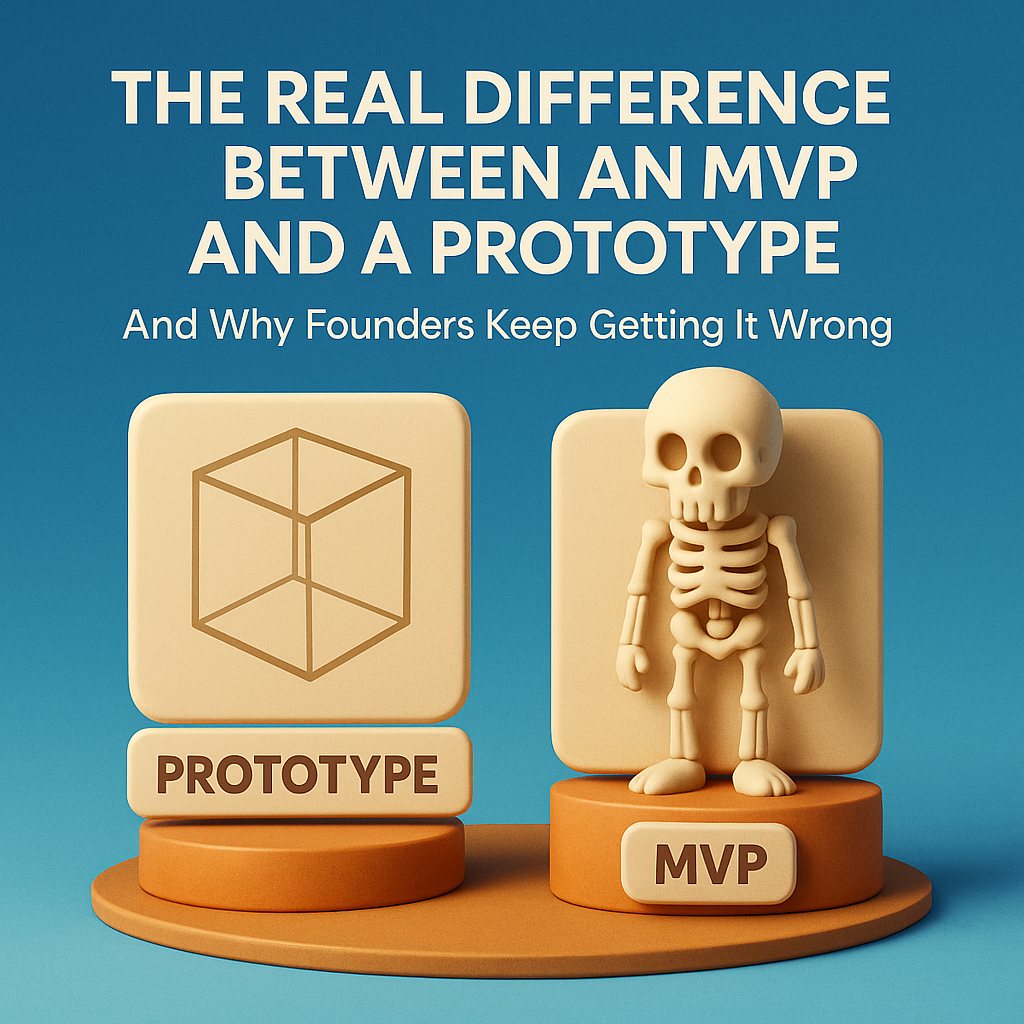
Let's define this clearly, without sounding like a textbook:
A prototype is a conversation tool.
An MVP is a market test tool.
A prototype helps you think.
An MVP helps you learn.
Different Questions, Different Answers:
- A prototype answers: "Is this idea possible?"
- An MVP answers: "Will people actually use this?"
This distinction is simple but profound — and it's exactly what most founders miss.
What a Prototype Actually Is
A prototype is:
- Unfinished — intentionally incomplete
- Unpolished — doesn't need to look production-ready
- Interactive only to demonstrate thinking — not fully functional
- Not meant for customers — internal validation tool
- Built to explore assumptions — "What if we tried this?"
- Made for internal validation — team alignment, not market testing
- Low-fidelity or mid-fidelity — wireframes, Figma mockups, clickable demos
- Often disposable — you should throw most prototypes away
Shape the idea. NOT ship the idea. Most founders think prototypes are "first versions" — they're not. They're thinking tools, not shipping tools.
What an MVP Actually Is
Explain that an MVP is a real product release, even if small.
It is:
- Functional — actually works for real use cases
- Reliable — won't crash or fail during testing
- Used by real customers — not just your team or friends
- Built with real data flows — captures usage, behavior, feedback
- Capable of testing traction — can people complete the core action?
- Designed to measure outcomes — metrics, not opinions
- Minimal but complete — one function done properly
Y Combinator's Definition:
"MVP stands for minimum viable product not minimum viable prototype. A prototype, however sophisticated, is not a product."
Test the market. NOT validate the concept internally. This is where founders go wrong — they think an MVP is meant to "look good" and "do everything." It's meant to measure if people care enough to use it.
Why Founders Keep Getting It Wrong (The Gold Section)
Here are the psychological and practical reasons founders fail:
1) Emotional Attachment to Their Idea
They want the perfect first version. The ego says: "I can't launch something ugly."
2) Misguided Pressure From Investors/Peers
They want to "prove traction" too early before understanding what to build.
3) Freelancers Misuse the Term
Everyone online calls everything an MVP. "I'll build you an MVP for $5K" usually means a Figma prototype or half-working demo.
4) Founders Build Features, Not Tests
But MVPs are about learning, not building. Y Combinator's Michael Seibel emphasizes: "It's better to have 100 customers that really love your product than 100k that are just ok with it."
5) Prototypes Are Sold as MVPs
Founders think they built an MVP when it's only a demo with beautiful animations and zero payment processing.
6) MVPs Are Built With Prototype Logic
Meaning: looks good, works terribly, no data collected, no real users testing it.
A founder spends 18 months and $500K building what he calls an "MVP." Perfect pixel spacing. Fancy animations. No payment processing. No real users. No validation. Just beautiful screenshots for pitch decks. This kills more companies than bad ideas, poor execution, or market timing combined.
Confused Whether You Need a Prototype or MVP?
Naraway helps Indian startups define the right product development strategy—so you don't waste months building the wrong thing.
Get Product Strategy ConsultationA Visual Mental Model You'll Remember For Life
Prototype = Sketch
MVP = Skeleton
The sketch helps you imagine the body.
The skeleton helps you understand if it can stand.
Prototype builds the "vision".
MVP tests the "viability".
This kind of metaphor makes concepts stick.
The 3 Laws of MVP vs Prototype (Blueprint Framework)
Prototype reduces building risk (Can we even make this?)
MVP reduces market risk (Will anyone actually pay for this?)
You should throw away prototypes after validation.
You should grow your MVP based on customer feedback.
Prototype = "Does this idea work technically?"
MVP = "Do customers care enough to use it?"
Founders' Mistakes Checklist (Self-Diagnosis)
If You're Doing Any of These, You're Confusing MVP and Prototype:
- Your first version needs "UI/UX perfection"
- You want to launch with 5–6 core features
- You're waiting months to release something
- You're afraid customers might hate this version
- You want it to "look professional before showing"
- Your team is doing full backend setups for an idea not validated
- You're avoiding real user testing
- You think "investors want polished products"
Y Combinator's Reality Check:
"Working > pretty. A Figma prototype is fine for hardware; software should be live."
YC doesn't care about polish. They care about speed and learning. On average, 40% of companies YC funds in each batch are just an idea — most don't have revenue or even an MVP yet.
The "Minimum Behavioral MVP" Idea (Innovative Twist)
Here's the modern understanding:
An MVP is not "the smallest product."
It is "the smallest test of behavior."
Examples of Real MVPs:
- WhatsApp-driven MVP — Customers message you on WhatsApp, you fulfill manually
- Manual backend MVP — You process orders by hand while customers think it's automated
- Non-coded workflow MVP — Use Airtable + Zapier instead of building custom software
- Landing-page MVP — Collect pre-orders before building anything
- Concierge MVP — Founders personally deliver the service to understand the workflow
Example: Dropbox's MVP
Drew Houston started with a simple demonstration video showing file syncing without building the full product. This video acted as an MVP to validate interest before writing code. It successfully attracted thousands of signups and investor attention—then Y Combinator and Sequoia Capital funded them.
The actual product launched in 2008 after this validation, growing into a billion-dollar business.
This creates a powerful mindset shift: Test behavior, not features.
What Happens When Founders Get This Wrong
The consequences are brutal:
- Long development cycles — 8-18 months before any market feedback
- Sunk cost fallacy — "We've invested so much, we can't change now"
- Product-market mismatch — Building what you imagined, not what users need
- Slow learning — Months pass with zero real customer insights
- Wasted budgets — ₹20-50 lakhs spent on features nobody wanted
- Team burnout — Building endlessly without seeing results
- Investor disappointment — "Where's the traction?"
- Delayed traction — Competitors move faster
- Building the wrong thing — Then realizing too late
- Scaling prematurely — Hiring team before validating demand
The cost of not testing with real users is often 10x higher than development costs. Six months spent building the wrong thing = six months a competitor spent learning and iterating.
Need Help Building the Right MVP?
Naraway helps startups go from idea to testable MVP in 4-8 weeks—not 6 months. We build minimum behavioral MVPs that test demand, not just look pretty.
Build Your MVP FastSoft Reality Check (Non-Salesy Authority)
Here's the simple, impactful truth:
One helps you explore your vision.
The other helps you build a business.
Prototypes are for founders.
MVPs are for customers.
Prototypes validate ideas internally.
MVPs validate demand externally.
This builds trust and authority without hard selling.
Building a Startup? Don't Make the $500K Mistake
Naraway helps Indian startups build MVPs that test real market demand—not just look good in pitch decks.
What we do:
✅ MVP strategy & planning (minimum behavioral MVP framework)
✅ Fast-track development (4-8 weeks to launch)
✅ Prototype vs MVP clarity (so you build the right thing)
✅ Y Combinator-inspired lean methodology
✅ Real customer testing, not friend/family feedback
📞 +91 63989 24106 | 📧 hello@naraway.com