Quick Answer
Early-stage startups struggle with hiring because decisions made fast, informally, and without execution clarity. Expectations are implicit, not explicit.
How This Guide Was Prepared
This guide was prepared by the Naraway editorial team using founder execution patterns, public market references, and practical operating experience from startup support work. It is designed to help readers make better decisions, not to manipulate search rankings.
Last reviewed: May 2026. Publisher: Naraway. Review focus: clarity, usefulness, factual consistency, and founder actionability.
Hiring in early-stage startups feels harder than it should. Founders spend weeks recruiting, interview extensively, extend offers to candidates who look perfect on paper. Then: performance underwhelms, culture fit misses, or hire leaves within months. Founder frustration: "We hired someone great but it didn't work out."
The issue usually isn't lack of talent—it's hiring execution. Startups don't hire wrong people as often as they design wrong roles and processes. Early-stage hiring breaks when: expectations implicit not explicit, founders carry context in heads not documentation, roles evolve faster than they're defined.
This article breaks down the 10 most common hiring mistakes early-stage startups make, and why they repeat across companies despite different industries, team sizes, and hiring contexts.
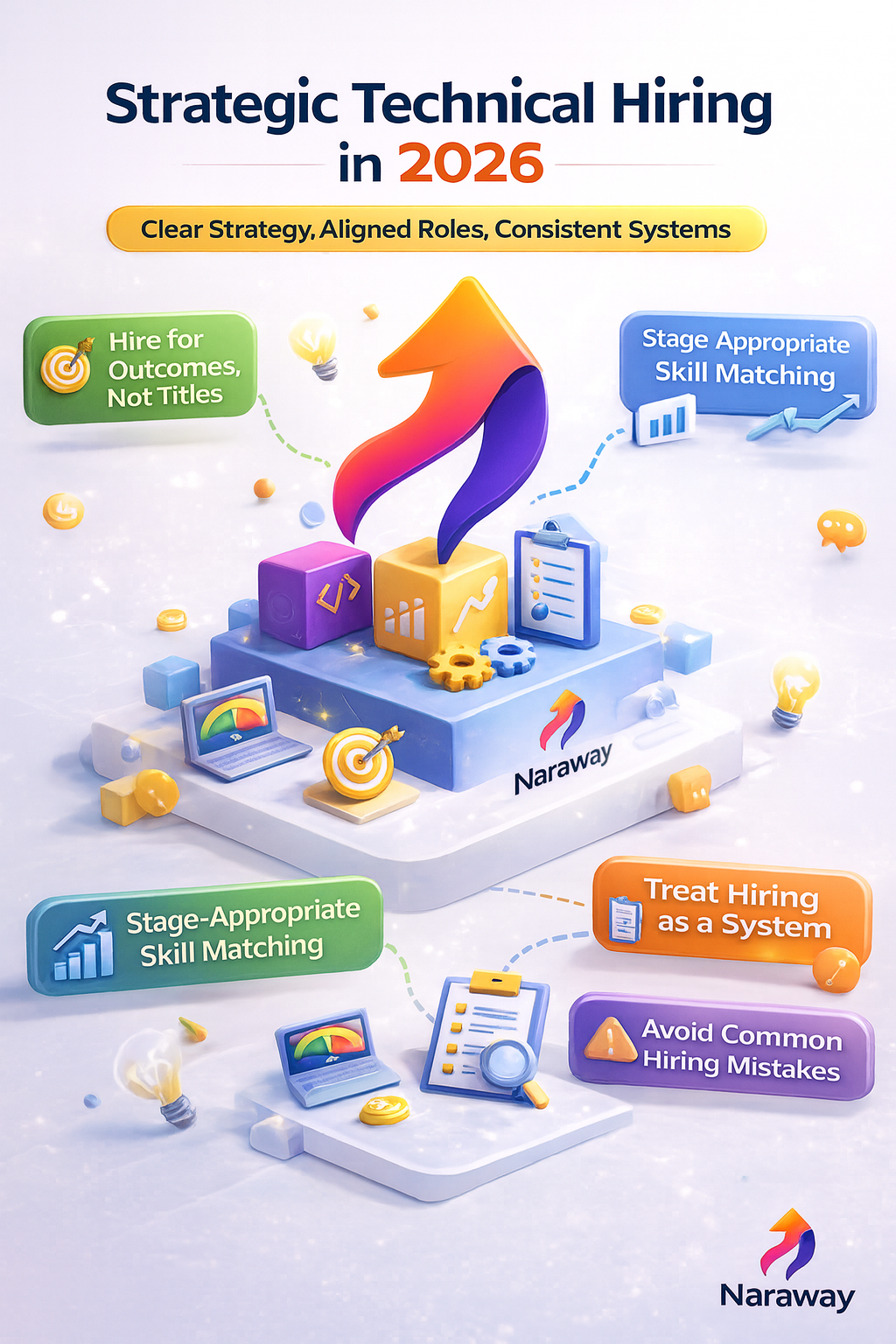
1. Hiring Before the Role Is Clearly Defined
What this looks like: Posting role with vague description: "We need a growth marketer." No clarity on: specific responsibilities, success metrics, required skills versus nice-to-haves, reporting structure, decision authority. Interview conversations reveal founders themselves unclear what success means.
Hire joins excited. Week one: confusion about priorities. Month one: misalignment on expectations. Month three: performance conversations revealing expectations were never explicitly communicated.
Why this happens: Urgency to fill capacity gap overrides role design discipline. Assumption that "we'll figure it out together" once hire starts. Founders know what they want implicitly but haven't articulated explicitly. Business needs evolving faster than role definitions can stabilize.
Why this creates failure: Undefined roles create undefined outcomes. Hire can't succeed against unclear criteria. Performance evaluation becomes subjective—"not what we expected"—when expectations were never defined. Capable person appears to underperform because role was never designed for success.
Key insight: role clarity prerequisite for hiring success. If founder can't articulate specifically what hire will do, what success looks like measurably, and what autonomy exists—role not ready for hiring yet. Our analysis of re-hiring patterns examines these failures.
2. Expecting One Hire to Do Multiple Jobs
What this looks like: Job description combining: content marketing, paid acquisition, SEO, analytics, graphic design. Or: frontend development, backend development, DevOps, product management. "Full-stack everything" expectations where one person expected to cover entire function's responsibilities. get your company registered and start building the team you need with Naraway
Hire initially excited by broad scope. Reality: impossible workload, constant context-switching, shallow execution across too many areas, burnout within months, quick exit leaving founder frustrated about "lack of commitment."
Why this happens: Early-stage resource constraints—can't afford multiple specialists. Assumption that generalists can handle breadth sustainably. Underestimation of workload when defining combined role. Survival mode prioritizing speed over sustainable role design.
Why this creates failure: Unrealistic scope guarantees underperformance. Even capable person can't execute five jobs well simultaneously. Broad responsibility without priority clarity creates paralysis. Burnout inevitable when expectations exceed human capacity. Quick exits attributed to "wrong hire" when actually caused by unreasonable role design.
Tie to early-stage resource pressure: constraint is real but solution isn't unrealistic expectations. Better: clearly prioritize within role scope, accept trade-offs explicitly, hire for depth in priority area with acceptable competence elsewhere rather than expecting expertise everywhere.
3. Founders Staying as the Hidden Bottleneck
What this looks like: Hire autonomy during interview process: "You'll own this function." Reality post-hire: every decision requires founder approval. Marketing campaign? Founder must review. Product feature? Founder decides. Hire execution requires founder involvement contradicting promised autonomy.
Hire initially operates independently. Gets feedback: "Should have consulted me first." Learns to seek approval for everything. Becomes order-taker not decision-maker despite being hired for leadership.
Why this happens: Founder genuinely wants delegation but struggles letting go. Early startup muscle memory where founder made all decisions. Fear of mistakes if autonomy real. Unclear boundaries about what hire decides versus requires consultation. Control retained subconsciously despite delegation promised explicitly.
Why this creates failure: Autonomy promised but control retained creates frustration. Capable hire becomes passive waiting for direction. Decision velocity slows requiring founder approval for routine matters. Hire feels micromanaged despite being told they own function. Eventually leaves seeking actual autonomy promised but never received.
Execution failure, not effort failure. Founder wants delegation sincerely. But delegation requires: explicit decision boundaries, tolerance for different approaches, systematic reduction of founder-only context. Without these, autonomy promise rings hollow.
4. Hiring for Speed Instead of Fit
What this looks like: Urgent need to fill role driving compressed timeline. Shorter interview process. Lowered evaluation standards accepting "good enough" candidate. Gut-feel decisions overriding systematic assessment. Role filled quickly but fit questionable from start. Naraway handles startup registration so your hiring can begin on a proper legal foundation
Three months later: performance gaps evident, culture misalignment creating friction, difficult conversations about whether hire working out. Six months later: separation discussion. Nine months later: starting hiring process over—back to empty seat consuming more time than slow careful hire initially.
Why this happens: Capacity gap creating immediate pain. Pressure from team needing support. Fear that prolonged vacancy worse than wrong hire. Market pressure competing offers forcing fast decisions. Belief that speed essential even if evaluation compromised.
Why this creates failure: Wrong hire costs exceed vacant role costs through: performance gaps requiring founder intervention, team friction from misalignment, delayed projects from capability mismatches, eventual re-hiring consuming 6-12 months total. Speed optimization should focus on process efficiency not evaluation compromise.
Reframe: slow hiring feels expensive—empty seat creates immediate capacity gap. Re-hiring is worse—wrong hire creates negative value while consuming resources then repeating entire hiring cycle. Fast hiring through better process: yes. Fast hiring through compromised evaluation: no.
5. Over-Indexing on Resumes Instead of Context
What this looks like: Candidate from Google, Facebook, Microsoft automatically gets interview. Resume shows brand names interpreted as capability signal. Hire joins. Struggles with: ambiguity typical of startups, resource constraints requiring scrappiness, rapid change requiring adaptability, hands-on execution versus strategic planning.
Big company experience valuable. But different context requires different capabilities. Structured environment with defined processes versus figure-it-out chaos. Large budgets and specialized roles versus do-more-with-less reality. Strategic work with support teams versus hands-on execution personally.
Why this happens: Resume brands create halo effect—assumed capability without context consideration. Belief that "best companies" produce "best people" universally. Underestimating context differences between large established companies and early startups. Hiring validation from prestigious backgrounds reducing perceived risk.
Why this creates failure: Context mismatch creates performance gaps. Capable in structured environment struggling in ambiguous one. Used to resources and support struggling with constraints. Strategic thinker uncomfortable with hands-on execution. Not lack of talent but poor context fit.
Avoid anti-resume tone—keep analytical. Big company experience can transfer well. Point is: evaluate context fit explicitly, not assume brand name guarantees startup readiness. Assess: comfort with ambiguity, resource constraint adaptability, hands-on execution willingness, rapid change tolerance.
6. Weak or Non-Existent Onboarding
What this looks like: Hire starts Monday. Gets laptop and Slack access. Pointed to codebase or marketing folder. Told: "Figure it out, ask questions if stuck." No structured onboarding plan. No context handover. No clarity on first priorities. "Figure it out" culture treating onboarding as sink-or-swim test.
Hire initially enthusiastic. Week one: confusion about who does what. Week two: uncertainty about priorities. Week three: frustration from lack of context. Month one: performance questions emerging. Month three: separation conversation—"not working out"—when actually onboarding failure not capability failure.
Why this happens: Founders too busy with urgent work to invest onboarding time. Assumption hire should operate independently from day one. Lack of documentation making knowledge transfer difficult. Early startup culture valuing scrappiness interpreting structured onboarding as unnecessary overhead.
Why this creates failure: Most hiring failures start after offer acceptance not during interviews. Interview evaluates potential. Onboarding determines actual success. Capable hire without context, clarity, or guidance struggles not from inability but from information absence. Firing decisions trace back to onboarding failures not hiring mistakes. Related to patterns in candidate experience gaps.
Key line: structured onboarding isn't bureaucracy—it's execution infrastructure. Minimum viable onboarding includes: tools access first day, key contacts and communication norms, documentation of critical context, first week clear priorities, regular check-in cadence. Investment pays through faster contribution and higher success rates.
7. Unclear Ownership & Decision Rights
What this looks like: Multiple people with overlapping responsibilities. Hire unclear what they decide independently versus requires consultation. Conflicts arising from boundary ambiguity. Everyone responsible means nobody accountable. Work falls through gaps between unclear territories.
Product manager and engineering lead both think they own roadmap prioritization. Marketing and sales both believe they own messaging. Finance and operations overlap on vendor management. Confusion creating conflicts, duplicated effort, or dropped responsibilities nobody claimed.
Why this happens: Small team operating informally with implicit coordination. Growth creating overlaps informal approach can't resolve. Roles defined by title not explicit boundaries. Assumption people will "figure it out collaboratively" without explicit ownership definition.
Why this creates failure: Boundary ambiguity creates constant friction. Hire can't operate confidently without clarity about authority. Decision paralysis from unclear escalation paths. Team dysfunction from coordination failures. Capable hires frustrated by structural ambiguity not addressed.
Tie to role design again: ownership clarity is role design element. Before hire starts, define explicitly: what this person decides independently, what requires collaboration with whom, what needs founder approval, clear boundaries preventing overlaps. Clarity enables autonomous contribution.
8. Inconsistent Interview Processes
What this looks like: Different interviewers assess different dimensions without coordination. Technical interviewer evaluates coding. Product interviewer evaluates communication. Founder evaluates culture fit. No shared rubric. Post-interview: conflicting feedback preventing clear decision. Gut-feel override systematic evaluation when convenient.
Candidate strong technically but weak communication. Hire or pass? Different interviewers weigh factors differently. Decision becomes political negotiation not objective assessment. Eventually gut-feel determines outcome rationalizing evaluation inconsistencies.
Why this happens: No standardized evaluation framework defining success criteria. Interview panel not aligned on priorities before process starts. Each interviewer using personal preferences as criteria. Ad-hoc interviewing versus systematic evaluation design. Growing team making informal coordination harder as more people interview.
Why this creates failure: Inconsistent evaluation produces inconsistent hires. Can't learn what works when process varies each time. Candidate comparison impossible without consistent criteria. Quality suffers when systematic framework absent. Hiring success becomes luck not design.
Execution discipline gap: evaluation criteria must be defined before interviews, shared across panel, applied consistently. Enables: clear candidate comparison, objective decisions, fair assessment, systematic improvement through learning what actually predicts success.
9. Ignoring Early Warning Signals
What this looks like: Early performance gaps noticed. Rationalized away: "Still ramping up." Communication issues observed. Explained: "Adjusting to culture." Small problems accumulate. Avoided through hope things improve naturally. Months pass. Issues compound. Eventually impossible to ignore requiring difficult conversations delayed too long.
Hire misses first deadline. "Understandable, new role." Second deadline missed. "Learning curve." Third deadline. Pattern clear but already six months invested. Separation discussion awkward having waited so long while issues obvious earlier.
Why this happens: Optimism bias hoping problems resolve naturally. Discomfort with difficult conversations. Investment rationalization—"we spent so much recruiting, let's give more time." Founder guilt about hire not succeeding. Unclear performance standards making objective assessment difficult.
Why this creates failure: Early signals ignored become later crises. Small gaps compound into large problems. Delayed feedback prevents course correction. Both hire and company waste time continuing misaligned relationship obvious to both parties. Separation inevitable becomes harder with time investment.
Relatable founder behavior: wanting hires to succeed, giving benefit of doubt, avoiding difficult conversations. But kindness is addressing issues early enabling course correction or fast separation, not prolonging inevitable while gaps compound.
10. Treating Hiring as an Event, Not a System
What this looks like: Every hire feels custom requiring starting from scratch. No repeatable process. Interview stages vary by candidate. Evaluation criteria change per role. Communication timing inconsistent. Onboarding improvised each time. Lessons from previous hires not documented, reviewed, or systematically applied.
Fifth engineer hired. Process different from first four. Seventh hire different from sixth. No learning accumulation. Same mistakes repeated. Quality inconsistent. Efficiency never improving despite multiple hires.
Why this happens: Early-stage treating hiring as occasional event not ongoing system. Growth outpaced process maturation—still operating on informal approach. Investment in systematization deprioritized because "too busy hiring." No retrospectives or improvement culture around hiring. Each hire tactical response not strategic system building.
Why this creates failure: Event-based hiring can't scale. Every hire requires reinventing process consuming setup overhead. Mistakes repeated because not systematically learned from. Knowledge remains in individual heads not organizational infrastructure. Hiring quality and speed capped by absence of systematic approach. Related to challenges in scaling execution.
Strong closing insight: systematic hiring enables: consistent quality through standardized evaluation, faster execution through established workflows, continuous improvement through documented learning, scalable growth through repeatable process. Investment in hiring system pays through every subsequent hire.
Why Hiring Mistakes Repeat in Startups
At Naraway, we see most early-stage hiring failures as execution design problems—not recruitment problems. Hiring is execution system where success depends on four elements:
Role clarity. Specific definition of: responsibilities and boundaries, success criteria measurable objectively, decision authority explicit, reporting structure clear. Role clarity enables: candidate evaluation against defined criteria, hire success assessment objective, performance management based on explicit expectations, autonomous contribution without constant guidance.
Ownership definition. Explicit boundaries about: what this person decides independently, what requires collaboration or consultation, what needs founder approval, clear interfaces with other roles. Ownership clarity prevents: boundary conflicts, decision paralysis, duplicated effort, dropped responsibilities.
Onboarding discipline. Systematic knowledge transfer including: tools and access, key contacts and norms, critical context documentation, first priorities clear, regular check-in cadence. Onboarding discipline ensures: faster contribution, higher success rates, reduced founder dependency, capability demonstration opportunity.
Reduced founder dependency. Hire can operate with: documented context not just founder knowledge, clear decision boundaries not everything requiring approval, autonomous execution possible within defined scope, founder involvement strategic not operational. Reduced dependency enables: scalable operations, hire empowerment, founder capacity for strategic work.
We frame hiring success as execution system problem. Startups with strong hiring don't just "pick better people"—they design better roles, create better onboarding, define better boundaries, enable better autonomy. These are operational design choices creating hiring success.
What Founders Should Fix Before Their Next Hire
Four foundational improvements transforming hiring outcomes:
Define outcomes, not just skills. Before hiring, articulate specifically: what success looks like in first 90 days, 6 months, 1 year with measurable outcomes, key deliverables expected, success criteria enabling objective evaluation. Outcome definition clarifies: role necessity, realistic expectations, evaluation framework, hiring urgency.
Clarify decision ownership. Document explicitly before hire starts: what they decide independently enabling autonomous execution, what requires collaboration with specific stakeholders, what needs founder approval with clear escalation criteria. Decision clarity prevents: micromanagement despite delegation promises, decision paralysis from boundary ambiguity, founder bottlenecks constraining velocity, hire frustration from unclear authority.
Standardize onboarding basics. Create minimum viable onboarding including: day one tools access and setup, key contacts with communication norms, documentation of critical tribal knowledge, first week priorities clearly defined, weekly check-ins first month. Onboarding investment pays through: faster time to contribution, higher hire success rates, reduced founder time explaining repeatedly, capability demonstration enabling fair assessment.
Reduce founder-only context. Document knowledge currently living only in founder head: product decisions and rationale, customer insights and preferences, strategic priorities and trade-offs, process norms and workflows, key relationships and contacts. Documentation enables: hire autonomous contribution, founder focus on strategic work, knowledge preservation beyond individuals, scalable operations as team grows.
These aren't templates or checklists—they're operational design improvements addressing root causes of hiring failures. Without these foundations, capable people join then struggle because role poorly designed, not because they're incapable. Our work on execution infrastructure explores these systems.
Final Reframe: Hiring Mistakes Don't Mean Your Startup Is Broken
Hiring mistakes don't indicate fundamental startup problems. They indicate execution systems haven't caught up with growth needs yet. Early-stage operates successfully through: founder centrality, informal coordination, implicit expectations, reactive problem-solving. These approaches enable initial speed and flexibility.
Growth makes these approaches inadequate: founder can't be involved in everything, informal coordination breaks with team size, implicit expectations create misalignment, reactive approach can't sustain velocity. But transition from early-stage informality to growth-stage systematization is skill gap not founder failure.
If hiring feels harder with every new role, problem isn't talent availability—it's execution infrastructure maturity. Fix isn't trying harder or getting lucky with next hire. Fix is: designing clearer roles before hiring, creating systematic onboarding, defining explicit boundaries, documenting founder-only context, treating hiring as system requiring investment.
Hiring failures are growth signals indicating operational maturation needed. Don't mean startup failing. Mean startup succeeding fast enough that informal approaches can't keep pace. Solution is systematization—building execution infrastructure enabling hiring success not just hoping next hire magically works.
Hiring mistakes aren't failures—they're learning opportunities revealing what needs systematization. Address execution gaps systematically and hiring transforms from recurring frustration to reliable growth engine.
Build Hiring Systems That Scale With Growth
Naraway helps early-stage startups design hiring systems enabling success through clear role definition, systematic onboarding, explicit ownership boundaries, and reduced founder dependency. We build execution infrastructure where hiring works reliably not just occasionally.
Design Hiring Infrastructure Schedule Assessment