Quick Answer
Startups don't fail to hire developers because they lack brand—they fail because they don't replace brand with clarity, structure, and trust.
How This Guide Was Prepared
This guide was prepared by the Naraway editorial team using founder execution patterns, public market references, and practical operating experience from startup support work. It is designed to help readers make better decisions, not to manipulate search rankings.
Last reviewed: May 2026. Publisher: Naraway. Review focus: clarity, usefulness, factual consistency, and founder actionability.
A 12-person startup posted a backend developer role. Well-written JD. Competitive compensation. Equity upside. Zero employer brand—no Glassdoor reviews, no TechCrunch coverage, no recognizable founding team.
Three weeks later: 40 applications, mostly junior developers from job boards. Two senior developers with relevant experience. Both stopped responding after initial screening calls. The founder's conclusion: "Good developers don't join unknown startups."
The actual problem: hiring process revealed execution gaps that brand normally masks. Vague answers about tech stack decisions. Delayed follow-up emails. Unclear role ownership. Founder improvising technical questions. Developers evaluated the startup through execution quality and concluded: high risk, low operational maturity.
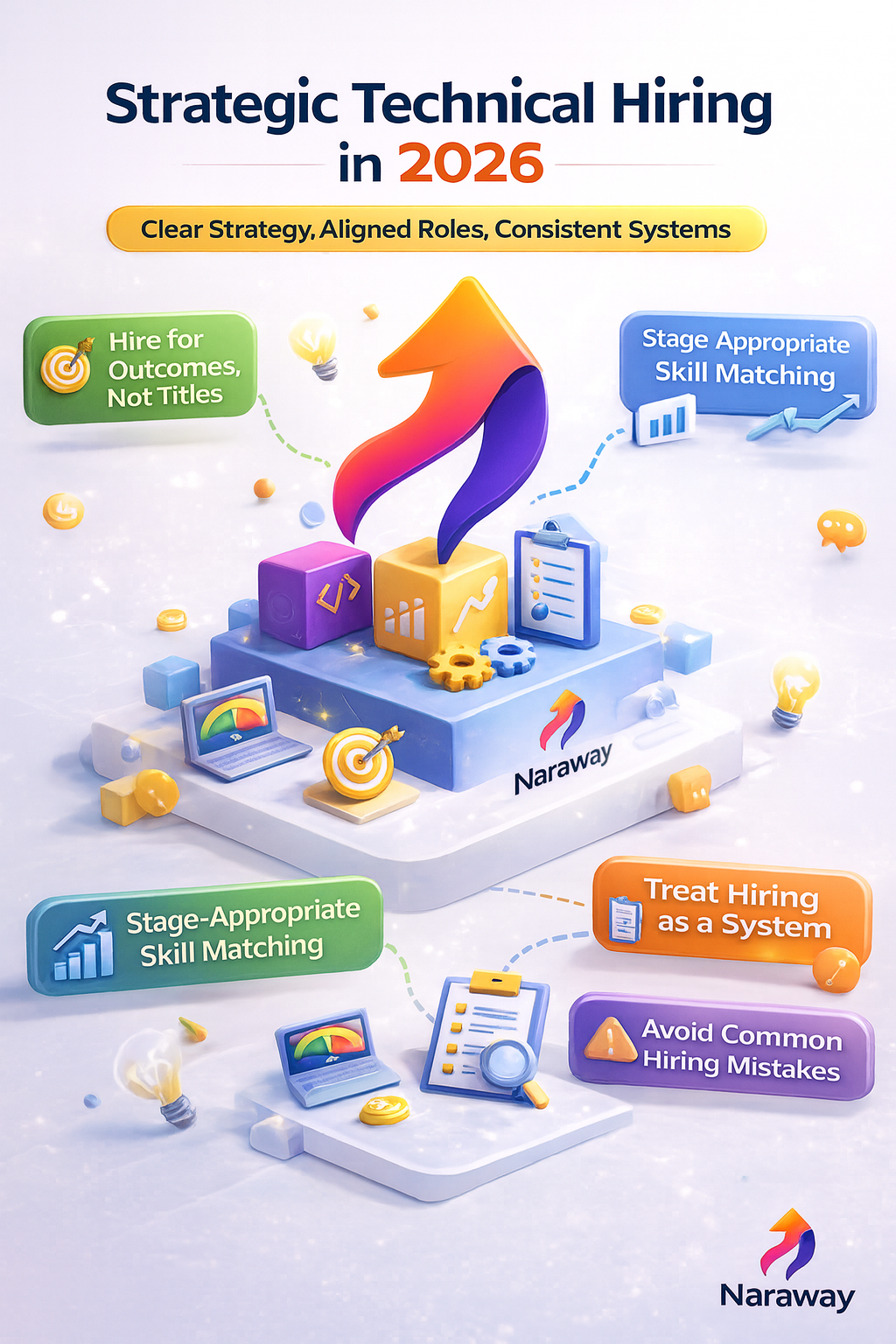
When a startup has no employer brand, every gap in clarity becomes risk signal for developers. Brand usually hides these gaps. Without brand, execution quality must do the work.
Why Hiring Developers Is Harder Without Employer Branding
Employer branding provides credibility shortcut. Developers see "Google" or "Razorpay" and assume stability, technical excellence, growth opportunities. Unknown startups get no such assumption.
Developers are risk-averse with careers and time. Joining unknown startup means betting 2-3 years minimum of career on something that might fail. No resume value if startup shuts down. No brand recognition for next job search. Skills might stagnate if tech stack choices are poor. The downside is concrete while upside is speculative.
Unknown startups look unstable by default. No track record. No public success indicators. No social proof from recognizable employees or investors. Developers default to skepticism: "Why haven't I heard of this company? Are they struggling? Will they run out of money?" The burden of proof is on the startup to demonstrate stability, not on developer to assume it.
Lack of social proof increases scrutiny. At branded companies, developers can research employee experiences on Glassdoor, find mutual connections on LinkedIn, read TechCrunch articles about funding. Unknown startups offer none of this validation. Every claim founders make during hiring requires independent verification because no external sources confirm credibility.
How Developers Actually Judge Unknown Startups
Developers evaluate unknown startups through execution proxies visible during hiring process. get your company registered and start building the team you need with Naraway
Clarity of role and tech stack. Job description says "backend developer" but actual responsibilities are vague. Will they build new features? Maintain existing systems? Design architecture? Set up infrastructure? Vague role descriptions signal founders haven't thought through what success looks like. Similarly, generic tech stack mentions ("modern frameworks, cloud infrastructure") without specifics suggest technical immaturity.
Contrast: "You'll own user authentication microservice built in Node.js with PostgreSQL, deployed on AWS ECS. You'll work with product team to design API contracts and mentor one junior developer." Specificity signals preparation.
Founder credibility in technical conversations. During screening calls, developers ask technical questions to evaluate founder understanding. "Why did you choose this architecture?" "How do you handle database migrations?" "What's your deployment process?" Founders who answer with depth and rationale demonstrate technical seriousness. Founders who deflect, give surface answers, or can't explain decisions reveal they're winging it.
Developers conclude: if founders don't understand tech deeply, technical decisions will be arbitrary and frustrating to work with.
Speed and structure of hiring process. Developers apply. Startup takes 10 days to respond. Screening call happens but follow-up takes another week. Interview gets scheduled then rescheduled twice. Each delay signals poor execution. Developers think: "If hiring is this disorganized, daily work must be worse." Our analysis of process gaps shows how execution quality signals extend across functions.
Quality of technical discussions. Technical interviews reveal whether startup respects developer craft. Thoughtful questions about architecture tradeoffs, code quality expectations, technical debt management show seriousness. Generic coding challenges copied from LeetCode or vague "tell me about your projects" suggest founders view developers as interchangeable resources not technical partners.
Consistency in communication. Founders say "we're building scalable architecture" but technical discussion reveals no monitoring, no automated testing, deployment is manual. Mismatch between claims and reality destroys trust. Developers interpret inconsistency as either dishonesty or ignorance—both are red flags.
Common Mistakes Startups Make When Hiring Without a Brand
These execution failures compound when startups lack brand credibility to absorb mistakes.
Vague job descriptions. "Looking for passionate developer to join our exciting journey building innovative solutions." This tells developers nothing. What technologies? What problems? What scale? Vague JDs signal founders haven't defined role clearly, suggesting they're hiring hoping someone figures it out later. Our first 10 hires guide explains role clarity importance.
Founders improvising technical interviews. No structured evaluation. Each candidate gets different questions based on founder mood. No consistent assessment criteria. Some candidates get grilled on algorithms. Others get casual conversations. This inconsistency suggests startup doesn't know what good looks like, making developers doubt their ability to grow technically.
Unclear product roadmap. Developer asks "what will I work on in first 3 months?" Founder answers "depends on what we decide to prioritize." Or "we're pivoting so it's flexible." Developers hear: no clarity. They want to know their work will matter, not get thrown away during constant direction changes. Pivots are fine if communicated as strategic. Chaos disguised as flexibility is concerning.
Changing expectations mid-process. Initial conversation mentions backend role. Second interview introduces frontend responsibilities. Offer discussion adds DevOps expectations. Scope creep during hiring signals scope creep during work. Developers prefer clear boundaries over "we all wear multiple hats" which often means "we haven't thought through responsibilities."
Delayed decisions and follow-ups. "We'll get back to you in 2 days" becomes 10 days with no communication. Developers lose interest not because timeline is long but because promises aren't kept. Unreliable communication during hiring suggests unreliable everything after joining. This connects to patterns we see in offer stage failures.
Why Salary Alone Doesn't Solve the Problem
Founders often think "we'll pay more than market" solves hiring challenges. It doesn't when perceived execution risk is high. Naraway handles startup registration so your hiring can begin on a proper legal foundation
Developers trade pay for certainty. Senior developer choosing between ₹25L at established company versus ₹30L at unknown startup evaluates beyond compensation. At established company: stable salary, known work culture, resume value, clear growth path, operational predictability. At unknown startup: higher cash but uncertain equity value, possible shutdown risk, unknown culture fit, unclear advancement.
The ₹5L premium doesn't compensate for uncertainty unless startup demonstrates execution maturity that reduces perceived risk.
High pay with chaos still feels risky. Paying ₹35L to developer joining chaotic startup where priorities change weekly, deployments break frequently, and founder makes arbitrary technical decisions creates burnout risk. Developers value stable work environment where they can do quality work over high pay in dysfunction. Money doesn't fix bad execution—it just compensates for tolerating it longer.
Startups oversell "future growth." "Join now at ₹20L but in 2 years you'll be leading 10-person team at ₹50L." Developers discount these promises heavily. They've seen startups fail, growth not materialize, equity become worthless. Present certainty beats future speculation. Unless startup can point to funded growth plan with clear milestones, growth promises feel like recruitment tactics not credible projections.
This is perceived execution risk: developer's assessment of whether startup can deliver on promises. Brand reduces this perception by providing external validation. No brand means every operational gap increases perceived risk exponentially, making salary premium insufficient compensation.
Why Developer Hiring Breaks at the Offer Stage
Even when unknown startups get developers to offer stage, acceptance rates are lower than branded companies for specific reasons.
Unclear equity logic. Offer includes 0.3% equity but no context. What's current valuation? What's vesting schedule? What's typical dilution path? How does equity convert during exit? Without brand credibility, developers scrutinize equity closely. Vague explanations suggest founders either don't understand equity themselves or are hiding unfavorable terms. Our salary negotiation analysis covers these patterns.
Inconsistent offers. Two backend developers with similar experience get ₹22L and ₹28L because founder negotiated differently. When they eventually compare, the ₹22L developer feels cheated. Inconsistency reveals absence of compensation framework, signaling operational immaturity that makes developers doubt everything else.
No clear ownership post-joining. Offer accepted but role scope remains vague. Who decides technical priorities? Who reviews code? What does success look like? How are conflicts resolved? Developers need to visualize their daily work. Vagueness creates anxiety about joining environment where responsibilities are unclear and accountability is ad-hoc.
Fear of joining "one-person-dependent" setup. All technical decisions flow through founder. No senior developer to learn from. No technical culture beyond founder preference. Developers worry about growth stagnation and becoming replaceable implementer rather than valued technical contributor. Brand companies offer known technical cultures. Unknown startups must explicitly demonstrate technical environment quality.
The Role of Process in Replacing Employer Brand
Startups without brand must out-execute branded companies in hiring process to compensate for credibility gap.
Structured hiring flow. Clear stages with defined timelines. Application screening (within 3 days) technical interview (within week) offer decision (within 2 days). Predictable process signals operational discipline. Developers trust startups that respect their time through structured coordination.
Clear evaluation criteria. Specific technical skills needed. Defined assessment methods. Consistent questions across candidates. Transparent feedback. Structured evaluation demonstrates startup knows what good looks like and can assess it systematically rather than subjectively. This builds confidence in technical culture quality.
Defined role scope. Documented responsibilities, expected outcomes, ownership boundaries, reporting structure, success metrics. Specificity replaces uncertainty with clarity. Developers can visualize their work and evaluate fit accurately. Vague roles require faith in founders. Clear roles require evaluation of documented responsibilities.
Transparent communication. Honest about challenges ("we're figuring out product-market fit"), clear about stage ("pre-revenue, 6 months runway"), explicit about expectations ("expect ambiguity and ownership"). Transparency builds trust more than overselling. Developers respect honesty about reality over unrealistic promises.
Predictable timelines. Commitments kept. If response promised in 2 days, delivered in 2 days. If timeline changes, proactive communication. Reliability in small commitments signals reliability in large commitments. Developers extrapolate hiring behavior to company behavior.
These process elements don't require tools or budget. They require intentional execution discipline. Our work on operational readiness shows how process quality signals organizational maturity.
Naraway Perspective: Hiring Developers Is an Execution Test
At Naraway, we don't view developer hiring as recruitment challenge. We treat it as execution test revealing technical maturity, operational clarity, and leadership readiness.
Weak developer hiring signals missing execution systems. When founders can't hire developers despite competitive offers, the gap isn't brand—it's infrastructure: Role definition processes that create clear scope before posting. Technical evaluation frameworks enabling consistent assessment. Compensation logic documented and defensible. Communication discipline showing operational maturity. Founder delegation allowing technical discussions without bottlenecks.
Developers evaluate startups through execution proxies visible during hiring. If hiring is structured, they assume operations are structured. If technical discussions are deep, they assume technical culture is serious. If communication is reliable, they assume daily coordination works.
Brand provides credibility shortcut. Unknown startups must earn credibility through demonstrated execution quality. This isn't disadvantage—it's different challenge requiring different approach. Replace brand attention with process excellence. Replace social proof with execution evidence. Replace reputation with demonstrated capability.
Build Developer Hiring Infrastructure
Naraway helps startups design technical hiring systems that convert developer interest into joins through clarity, structure, and execution maturity. We build infrastructure that replaces brand credibility with operational excellence.
Fix Developer Hiring Schedule AssessmentWhat Startups Should Fix Before Posting the Next Developer Role
System-level fixes that reduce perceived execution risk for developers evaluating unknown startups.
Define ownership and expectations. Document exactly what developer will own, who they report to, what success looks like, how decisions get made, what problems they'll solve. Remove vagueness that forces developers to fill gaps with skeptical assumptions. Clarity demonstrates preparation which signals operational maturity.
Structure interviews. Create consistent technical evaluation. Define what you're assessing (architecture thinking, code quality, problem-solving, communication). Prepare questions that reveal these dimensions. Use same framework across candidates. Avoid founder improvisation that creates inconsistency. Structured assessment signals you know what good looks like.
Align compensation logic. Document internally how you arrived at compensation numbers. What benchmarks used? What's negotiable? How does equity work? Why this structure? Having clear logic enables confident explanation to candidates. Vague "we think this is fair" destroys credibility. Data-driven compensation builds trust.
Remove founder-only dependency. Enable technical leads or senior developers to conduct meaningful technical discussions. Founder shouldn't be required for every hiring conversation. Distributed technical evaluation signals technical culture exists beyond founder, making startup less risky for developers considering joining.
Final Reframe: Employer Branding Attracts Attention. Execution Earns Trust.
Startups without brand need different strategy, not resigned acceptance that good developers won't join.
Brand gets attention through recognition. Unknown startups get attention through targeted outreach and referrals. But attention alone doesn't close hires. Trust closes hires. Trust comes from demonstrated execution quality throughout hiring process.
Every interaction is evaluation opportunity. Response speed, technical depth, communication clarity, role specificity, process predictability—developers synthesize these signals into risk assessment. Brand provides positive bias. No brand means neutral bias requiring positive evidence.
Startups without brand must out-execute, not out-promise. Better hiring process. Clearer role definition. Deeper technical discussions. More reliable communication. Higher operational transparency. These aren't compensation for lack of brand—they're execution fundamentals that matter regardless of brand but become critical when brand doesn't exist.
If developers drop out despite good conversations, the issue isn't branding—it's execution gaps exposed during hiring. Fix the infrastructure. Execution quality becomes your brand.
Replace Brand with Execution Excellence
Naraway helps startups without employer brands hire developers through systematic execution that demonstrates operational maturity. We build technical hiring infrastructure that earns developer trust through clarity and discipline.
Build Hiring Systems