GPT-5.6 Sol: OpenAI's Strongest Model, Three Tiers, and a Deliberate Rollout
OpenAI previewed the GPT-5.6 family on June 26, 2026, and the announcement is worth reading carefully rather than skimming. This is not an incremental update. GPT-5.6 introduces a new model naming convention, three distinct capability tiers under one family, a significantly strengthened safety architecture, and benchmark results that shift the frontier on coding, biology, and cybersecurity. Whether you are an engineer deciding which model to call, a founder budgeting AI costs, or a team evaluating which tools to build on: the details matter here.
Sol, Terra, Luna: Why Three Models Matter
Previous OpenAI model families gave you a flagship and a mini. GPT-5.6 introduces a more structured three-tier system where each model has a defined role, and the naming is designed to be durable across generations. The number identifies the generation; Sol, Terra, and Luna identify capability tiers that can each evolve independently.
GPT-5.6 introduces a structured three-tier system, Sol, Terra, and Luna, with a phased rollout. The number marks the generation and the tier names mark durable capability levels.
This matters for teams building on the API. If you are designing a product that chains multiple AI calls, you can now use Sol for the complex reasoning step, Terra for the drafting and summarization layer, and Luna for the high-volume classification or routing work, all within the same model family, consistent behavior, and clearer cost modeling.
Terra is particularly interesting from a cost standpoint. OpenAI claims it delivers performance competitive with GPT-5.5 at half the price. For teams currently running GPT-5.5 at scale, that is a significant number to test before the model hits general availability.
Planning to migrate from GPT-5.5 to the GPT-5.6 family? Naraway helps teams design multi-model architectures that balance cost and capability across tiers.
See LLM Integration ServicesBenchmark Results: Where GPT-5.6 Stands
OpenAI shared three benchmark areas with the preview: coding, biology, and cybersecurity. These are not general knowledge tests; they are agentic evaluations where the model must plan, use tools, iterate, and complete multi-step tasks. That distinction is important when comparing numbers.
Coding: TerminalBench 2.1
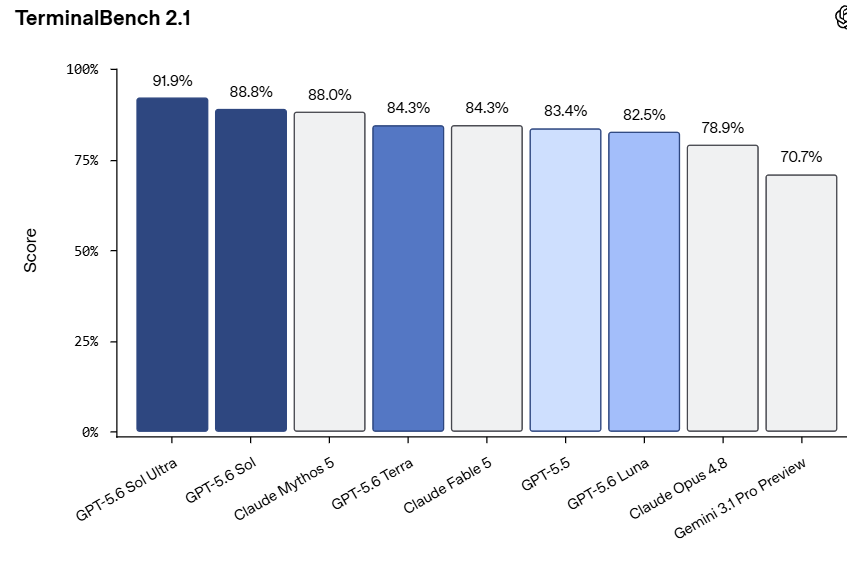
TerminalBench 2.1 tests command-line workflows that require planning, iteration, and tool coordination. It is a closer proxy to real engineering work than static coding challenges. Here is where the models land:
The number to notice is Luna at 84.3%: it matches Claude Mythos 5 on this benchmark while being priced at $1 per million input tokens. For teams doing agentic coding work at volume, that cost-to-capability ratio is the most interesting number in the entire release.
Biology: GeneBench v1
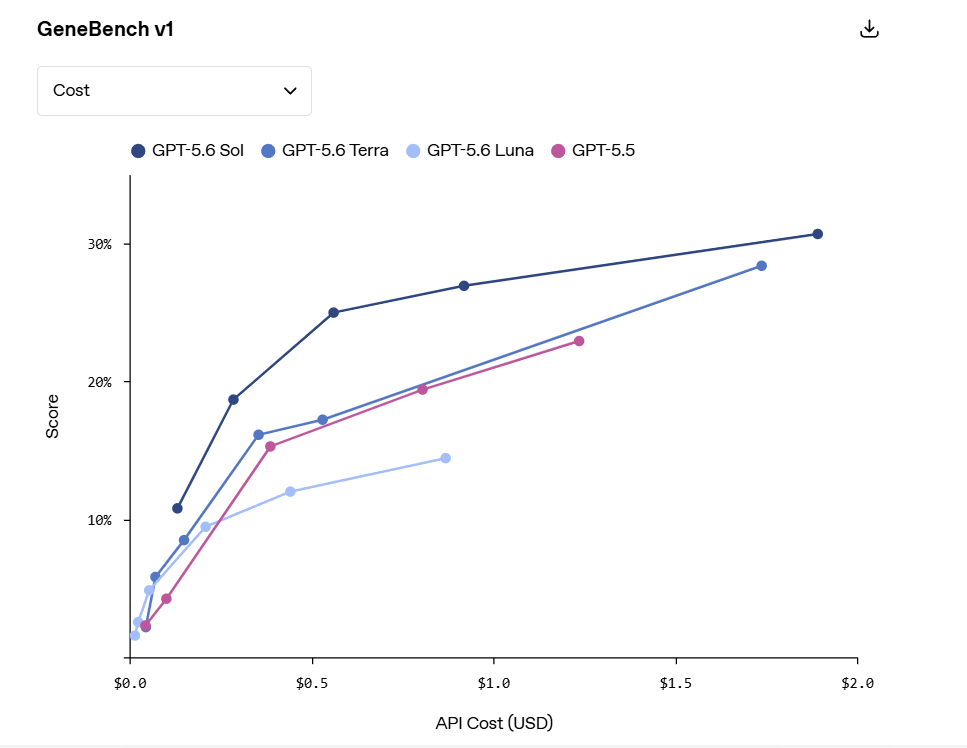
GPT-5.6 Sol improves on GPT-5.5 on long-horizon genomics and quantitative biology analyses, and does so while using fewer tokens on cost-equivalent runs. The GeneBench v1 chart below plots score against API cost for each tier — Sol pulls significantly ahead of Terra, Luna, and GPT-5.5 as compute budget increases.
Cybersecurity: ExploitBench and ExploitGym
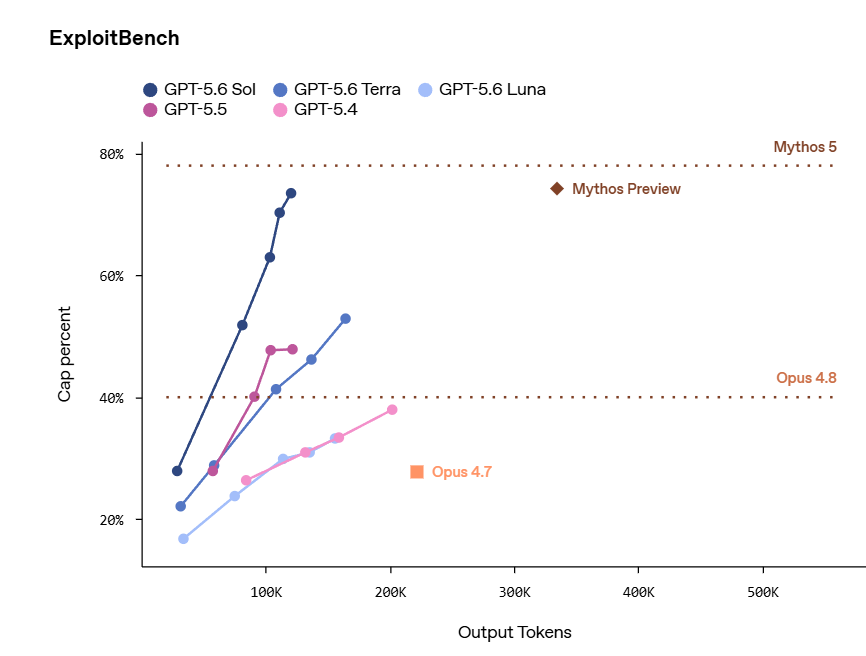
On ExploitGym, a benchmark developed in collaboration with UC Berkeley researchers, all three GPT-5.6 models show strong improvements in cyber capability as reasoning effort increases. On ExploitBench, Sol matches Mythos Preview performance while using roughly one-third the output tokens. These are dual-use capabilities, and OpenAI has addressed that directly with the safety architecture described below.
Ultra Mode and Max Reasoning: What They Actually Do
GPT-5.6 Sol introduces two new capability modes. Max reasoning effort gives the model more time to think deeply before responding. This is not a temperature setting; it is a deliberate allocation of inference compute to longer chains of reasoning before the model commits to an output.
Ultra mode goes further. Instead of one agent handling a task sequentially, ultra mode deploys subagents to work on parts of a task in parallel, then synthesizes the results. The 91.9% TerminalBench score is Sol in ultra mode versus 88.8% in standard. The tradeoff is cost and latency: parallel subagents use more tokens and take more wall-clock time to coordinate. For tasks where correctness matters more than speed, that is the right tradeoff.
For developers, this creates a practical decision framework: use standard Sol for reasoning-heavy single-pass tasks, use ultra when the task can be decomposed and parallelized, and fall back to Terra or Luna for tasks where speed and cost are the primary constraint.
Deciding between Sol, Terra, and Luna for your product? Naraway designs AI architectures matched to what you're actually building, not the most expensive option by default.
Talk to Us on WhatsAppThe Safety Architecture: Seven Layers, Not One
OpenAI's safety announcement deserves more attention than it typically gets. The GPT-5.6 preview was accompanied by a layered safeguard stack, and the approach is more sophisticated than "we refused bad requests."
- Model-level training to refuse prohibited assistance, including disguised intent and jailbreak attempts
- Real-time cyber and biology misuse classifiers that evaluate output as it is generated
- Generation pauses: when classifiers flag a potential violation, a larger reasoning model reviews the conversation before the output is returned
- Account-level review that looks across conversations, not just the current one, to distinguish malicious patterns from legitimate dual-use work
- Differentiated access: the most sensitive capabilities are not available by default
- Monitoring and enforcement operating post-delivery
- Over 700,000 A100-equivalent GPU hours dedicated to automated red-teaming for universal jailbreaks
On Chromium and Firefox exploit testing, Sol identified bugs and exploitation primitives but did not autonomously produce a functional full-chain exploit under the conditions tested. OpenAI's Preparedness Framework classifies this as below the Cyber Critical threshold. The phased rollout is explicitly tied to validating the safeguards under real-world adversarial pressure before broader access.
For teams in regulated industries: financial services in Singapore or the UAE, healthcare in India, legal tech in the UK, this safety transparency matters. Deploying a model with documented, tested, layered safeguards is a materially different conversation with compliance teams than deploying one that is simply "aligned."
The Phased Rollout: What It Means and Why It Matters
GPT-5.6 launched into limited preview for a "small group of trusted partners," with the US government informed in advance and asked to be consulted on the rollout. OpenAI was explicit that this should not become a long-term default: government-first access keeps capable tools away from developers, enterprises, and cyber defenders who need them.
The public commitment is general availability via ChatGPT, Codex, and the API in the coming weeks. What that means practically: if you are planning to build on GPT-5.6, now is the time to review the system card, design your architecture for the tier you intend to use, and understand the tokenizer and prompt caching changes before you are under launch pressure.
Prompt Caching: A Meaningful Change
GPT-5.6 introduces explicit cache breakpoints and a 30-minute minimum cache life. Cache writes are billed at 1.25x the uncached input rate; cache reads receive a 90% discount. For applications with long system prompts or repeated context, this caching structure can meaningfully reduce per-call costs. Design your prompts with caching in mind from the start.
Cerebras at 750 Tokens Per Second
OpenAI is launching GPT-5.6 Sol on Cerebras hardware at up to 750 tokens per second in July, with initial access limited to select customers. At that speed, applications that previously needed pre-generated responses or streaming workarounds can deliver real-time results even for long-form outputs.
This is especially relevant for voice AI, real-time coding assistants, live customer support agents, and any application where response latency is a product metric. 750 tokens per second is roughly 10x the throughput of standard API delivery.
What to Do Before General Availability
The preview window is not a waiting period. It is preparation time. The teams that will move fastest when GPT-5.6 opens up broadly are those who have already done the architecture work, not those scrambling to figure it out after access arrives.
- Read the GPT-5.6 system card: the safety architecture details matter for regulated deployment
- Audit your current GPT-5.5 costs: Terra may deliver similar performance at half the price, changing your unit economics
- Design for tier selection: identify which parts of your pipeline need Sol versus Terra versus Luna
- Account for the new tokenizer and caching structure in your cost models
- If latency is critical to your product, get on the Cerebras waitlist for the July rollout
- For teams doing security work: review the differentiated access model to understand what requires elevated permissions
Need Help Planning Your GPT-5.6 Migration?
Naraway designs AI systems for startups and enterprise teams: multi-model pipelines, agentic workflows, and cost-efficient architectures. If you are evaluating GPT-5.6 for production or building for the first time, we can help you scope it correctly from the start.
Explore AI Integration